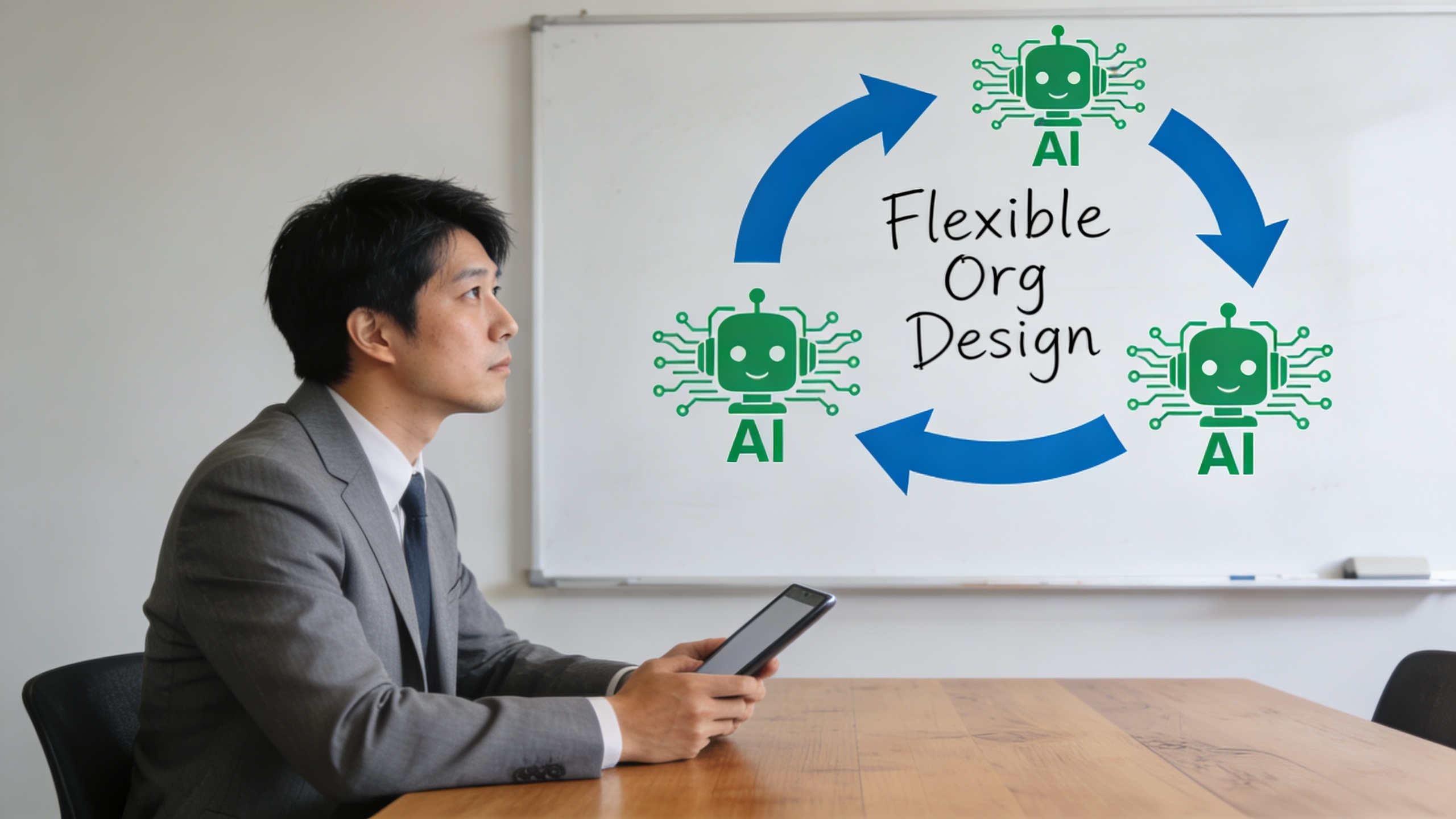
- The Risks Lurking in the Rush to AI Adoption and Organizational Change
- Learning the Art of “Temporary Placement” from AsiaQuest’s Case
- The Essence of Organizational Change as Shown by MSOL’s Conference
- Learning the Concept of “Surplus Assets” from Administrative Reorganization
- Three Checkpoints for Designing a Reversible Organization
- Conclusion: In the AI Era, “Reversible Design” Becomes a Competitive Advantage
The Risks Lurking in the Rush to AI Adoption and Organizational Change
“AI will streamline operations” and “Organizational change will boost competitiveness”—these phrases may sound familiar to SME managers.
At the “Global Management Conference” hosted by MSOL, discussions centered on organizational change in the era of rapid AI expansion. Meanwhile, AsiaQuest has published its initiatives and results regarding AI-driven organizational transformation.
What both companies share is a view of AI adoption not merely as a tool replacement, but as an opportunity to rethink organizational structures themselves. However, what deserves attention here is the irreversibility inherent in the word “change.”
Once set in motion, changing an organization is difficult to undo. Assigning people, fixing roles, and altering evaluation systems—all of these are decisions that are hard to reverse.
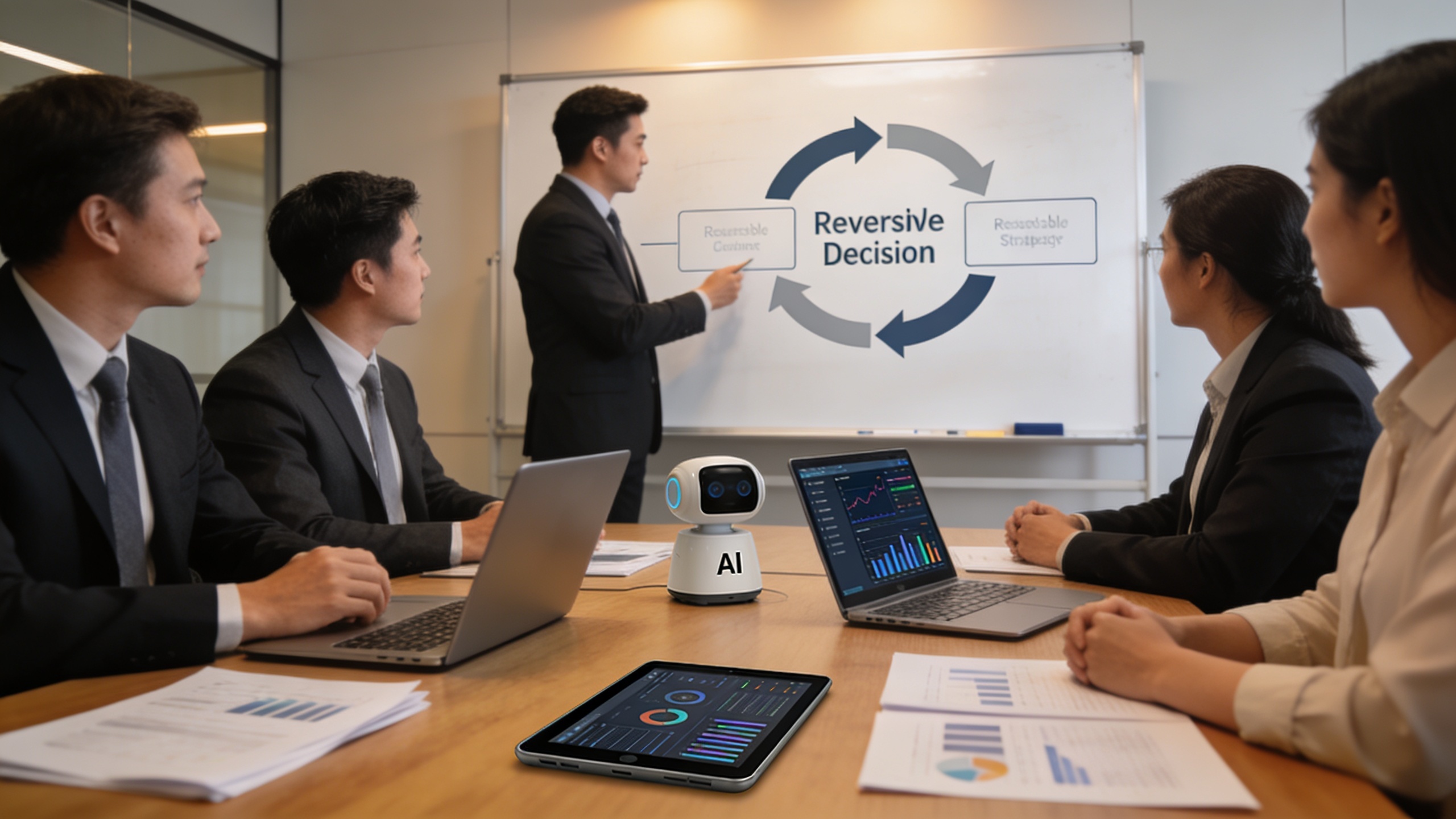
That’s precisely why organizational change in the AI era requires a “reversible design.”
Learning the Art of “Temporary Placement” from AsiaQuest’s Case
A key feature of AsiaQuest’s AI-driven organizational transformation is its phased approach. Rather than rolling out AI company-wide all at once, the company starts with specific departments or tasks, verifying effects before expanding.
The essence of this method lies in the philosophy of “prioritizing observation over fixation.”
A common mistake many companies make is, upon deciding to adopt AI, immediately appointing an “AI person,” forming a dedicated team, and drawing up a company-wide rollout schedule. This makes it impossible to backtrack if AI’s effects fall short of expectations or if on-the-ground resistance is strong.
AsiaQuest’s approach involves first establishing a “temporary AI team” for a limited period, setting an evaluation phase, and then moving to full-scale deployment. During this “temporary placement” stage, it’s crucial to monitor the following points:
- How much has work time changed before and after AI introduction?
- Are team members consistently using the AI tools?
- Have any unexpected tasks or issues arisen?
- Are employees’ skills declining due to over-reliance on AI decisions?
Based on these observations, decisions are made on whether to proceed with full-scale deployment, try a different approach, or withdraw. This is the foundation of “reversible management.”
The Essence of Organizational Change as Shown by MSOL’s Conference
Reports indicate that MSOL’s conference discussed organizational change in the AI era as “a means to create new value.” What’s noteworthy here is the relationship between means and ends.
Organizational change is not a goal; it’s merely a means. Yet, cases where change itself becomes the goal are endless. Many managers, driven by the compulsion that “since we’ve introduced AI, we must change the organization,” push through forced transformations.
The depth of MSOL’s discussion lies in its emphasis on the process of “thoroughly observing current operations” before any change. What will change with AI adoption, and what won’t? Moving the organization without understanding this leads to an accumulation of irreversible decisions.
Visualize the Current State Before Change
Before proceeding with organizational change, first visualize your current business processes. Who does what tasks, and based on what judgments? The key is to see these as “tasks” rather than “people.”
For example, when introducing AI in a sales department, try observing the following:
- How much time does it take to create quotes?
- Who inputs and updates customer information?
- What criteria are used to prioritize deals?
- Which parts rely on the personal know-how of individual sales reps?
Based on these observations, clearly separate tasks to be handled by AI from those to remain with humans. Then, treat this division itself as a “temporary placement” and create a system for regular review. This is the design of a “reversible organization.”
Learning the Concept of “Surplus Assets” from Administrative Reorganization
News about Vietnam’s administrative reorganization outlined a policy to “accelerate the disposal of surplus public assets after restructuring.” This teaches us the reality that organizational change inevitably creates “surplus.”
The same occurs in corporate organizational change. Tasks, personnel, and systems rendered unnecessary by AI adoption—how these are handled determines the success or failure of the transformation.
Particular attention is needed for “surplus people.” When AI streamlines tasks, the roles of those previously handling them disappear. At this point, rather than simply cutting staff, the ability to “temporarily place” people in new roles is essential for designing a reversible organization.
The Choice Not to Fix People in Place
Reports on AsiaQuest’s case indicate that when reallocating surplus personnel created by AI adoption to new business areas, they started with “limited-term project teams.” This is a method of not fixing roles, but exploring optimal placements while observing the actual situation.
This concept is especially important for SME managers. Unlike large corporations, SMEs with limited personnel flexibility cannot easily change assignments once made. Therefore, it’s crucial to set a “temporary placement” period from the start, include an evaluation phase, and then move to permanent assignment.
Three Checkpoints for Designing a Reversible Organization
Here are checkpoints for achieving reversible decisions in organizational change during the AI era.
Set an Evaluation Period
Before starting organizational change, always decide “when to evaluate.” Three months, six months, one year. Setting this period allows for objective measurement of the change’s effects.
Evaluation criteria should be multifaceted, including not only sales and profits but also changes in work hours, employee satisfaction, and customer feedback.
Define Exit Conditions in Advance
Before starting the change, decide on conditions like “if effects don’t reach this level, revert to the original structure.” This isn’t admitting defeat; it’s a wise management decision.
Defining exit conditions allows for decisions free from emotional bias. You can calmly assess the situation without being trapped by sunk costs like “we’ve invested this much.”
Design a Method to Revert
When making organizational changes, also consider how to revert to the original structure. Specifically, check the following points:
- Are pre-change workflows and rules documented?
- Are pre-change systems and tools readily reusable?
- Have pre-change personnel left due to transfers or resignations?
- Are there any aspects that cannot be reverted due to contracts or relationships with partners?
Neglecting these checks can lead to a situation where you want to revert but cannot.
Conclusion: In the AI Era, “Reversible Design” Becomes a Competitive Advantage
As the cases of MSOL and AsiaQuest show, organizational change in the AI era is an unavoidable theme. However, chasing only the speed of change and accumulating irreversible decisions is dangerous.
For SME managers, the cost of reverting an organization once moved is incomparably higher than for large corporations. That’s precisely why incorporating a “reversible design” from the start leads to long-term competitiveness.
Abandon the illusion that “AI will solve everything” and start by thoroughly observing your own operations. Then, treat change as an “experiment,” proceeding with clear evaluation periods and exit conditions. This is the essence of “reversible management” for surviving the AI era.
It’s not about management that never makes mistakes, but management that can recover from them. Why not take the first step toward that today?

Comments