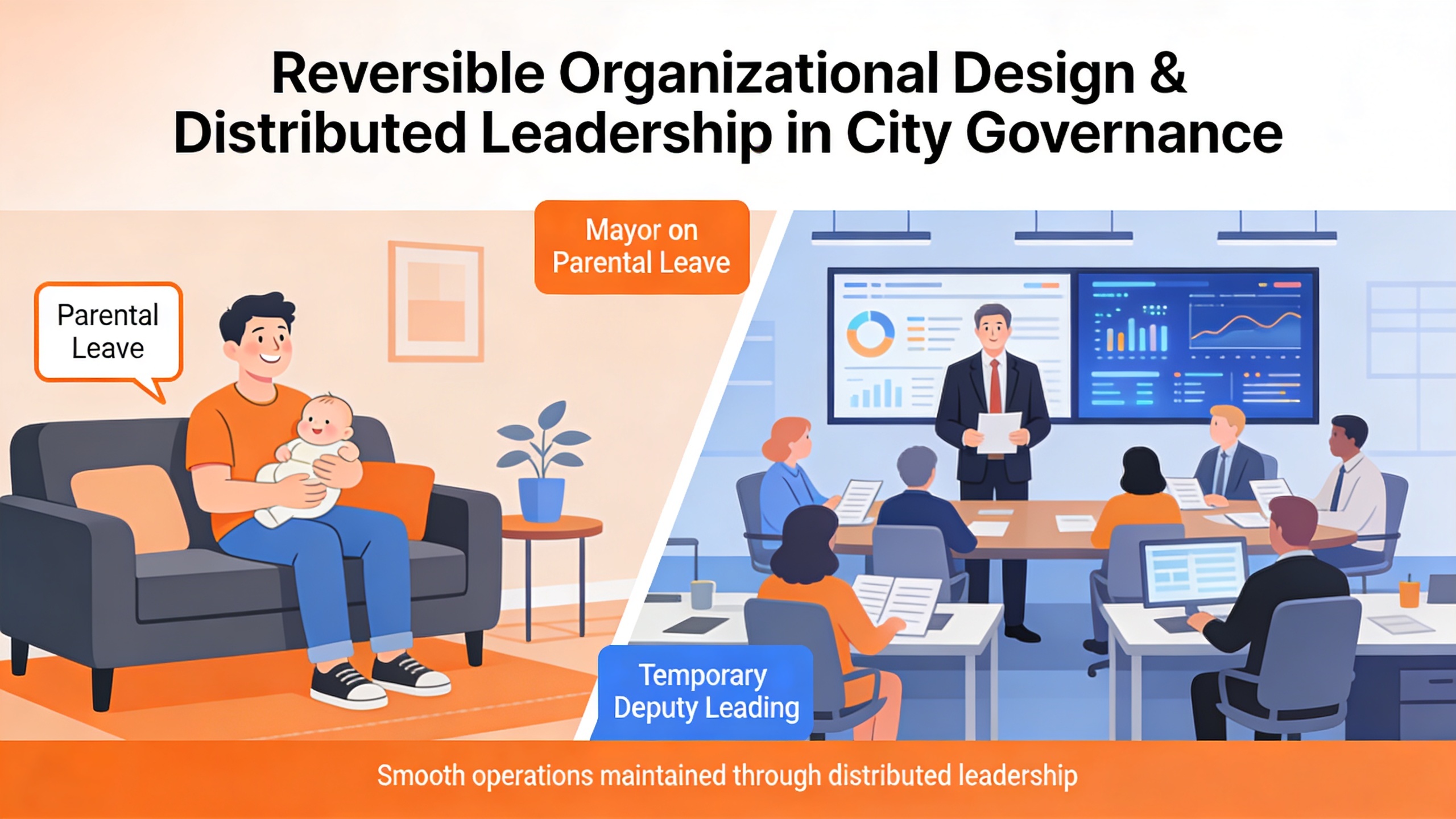
Why a Mayor’s Maternity Leave is Called “the Best Management Decision”
Recently, news of a mayor taking maternity leave sparked discussion. While some praised it as “the best management decision,” it also drew criticism from certain council members.
This story holds valuable lessons for small business owners. After all, a situation where the head of an organization is temporarily absent can happen in any company—due to illness, accidents, or caregiving, for example.
From the perspective of “returnable management,” this news raises a fundamental question: how do you design an organization’s “reversibility”? An organization that functions even when its leader is away, and allows for a smooth return when they come back—that is the key to sustainable management.
What Does It Mean for an Organization to Be “Returnable”?
In many small businesses, tasks and decisions are concentrated in the hands of the president or key personnel. While this may seem efficient at first glance, if that person suddenly disappears, the organization grinds to a halt. This is a “non-returnable” state.
A “returnable organization” is one that doesn’t depend on any specific individual—it functions whether someone leaves or comes back. Consider the mayor’s maternity leave. The mayor steps away from their duties for several months, but city hall operations don’t stop. The deputy mayor and senior staff take over, and daily administrative services continue.
This is possible because the organization has a built-in “substitution system.” Rules for delegating authority, decision-making criteria, and information-sharing processes are all in place, allowing the organization to be “returnable” even without its leader.
On the other hand, the criticism from council members is also noteworthy. It may reflect a fixed mindset that “the leader should always be present,” or the view that “a leader’s absence is a sign of organizational weakness.” But in reality, a truly weak organization is one where the leader shoulders everything alone and cannot step away.
Designing a “Substitution System” for Small Businesses
So, how can small businesses specifically design a “returnable organization”? The key lies in the following three points.
Link Authority to “Roles,” Not “People”
In many small businesses, authority is delegated on a personal basis—”that person decides.” But if that person takes a break, decision-making stops. Instead, link authority to roles: “up to this amount, this position decides.”
For example, create a system where a deputy manager can approve decisions even if the manager is away. Or, for certain matters, allow employees with a specific level of experience to make decisions, regardless of their title. This prevents work from stalling due to an individual’s absence.
Shift from “Vague Expectations” to “Clear Rules”
An organization that operates on the expectation that “that person will understand” is dangerous. If that person is away, no one can decide. Clarify decision-making criteria and create manuals.
For instance, set specific rules like: “For complaint handling, if the amount is under a certain threshold, the front-line staff decides; if it’s above, consult a supervisor.” This increases the likelihood that anyone making a decision will reach the same conclusion. It also enhances the “reversibility” of decisions—if a wrong decision is made based on a rule, you can simply revise the rule itself.
Move Information from “Inside One Person’s Head” to “a Shared Space”
The biggest cause of a “non-returnable” state is the personalization of information. A situation where “only that person knows” is a fundamental organizational vulnerability. Make it a habit to store all important information—daily reports, meeting minutes, project progress—on a shared drive or internal social network.
In one company I consulted for, the president handled all negotiations with clients alone. When the president was hospitalized, no one could take over those relationships, and sales plummeted. This is a classic example of information and relationships being completely “fixed to an individual.”
Afterward, they started recording all sales discussions in a CRM and made it a rule for multiple staff members to attend meetings with key clients. As a result, sales operations ran smoothly even without the president. This was the first step toward a “returnable organization.”
The Side Benefits of a “Returnable” Design
Designing a “returnable organization” isn’t just about risk management. It also contributes to the overall growth of the organization.
When authority is delegated and decision-making criteria are clear, employees can think and act independently. This boosts employee engagement. Additionally, when information is shared, inter-departmental collaboration becomes smoother, and new ideas are more likely to emerge.
Business owners may fear creating an organization that runs without them. But that is precisely the owner’s greatest task. An organization that runs without you becomes stronger when you return. This is the ideal form of “returnable management.”
Summary: Maternity Leave as a Litmus Test for a “Returnable” Organization
A mayor’s maternity leave acts as a litmus test for an organization’s “returnability.” The fact that it drew criticism may be evidence that the organization is still designed on the premise that “the leader should always be there.”
To all small business owners: could your company survive if you took three months off? If the answer is “no,” that’s a sign of a “non-returnable organization.” Start today by delegating authority, clarifying decision-making criteria, and sharing information.
A “returnable organization” is far stronger than one that depends on a single superhuman. And above all, giving the business owner the space to “return” is the first step toward sustainable management.

Comments