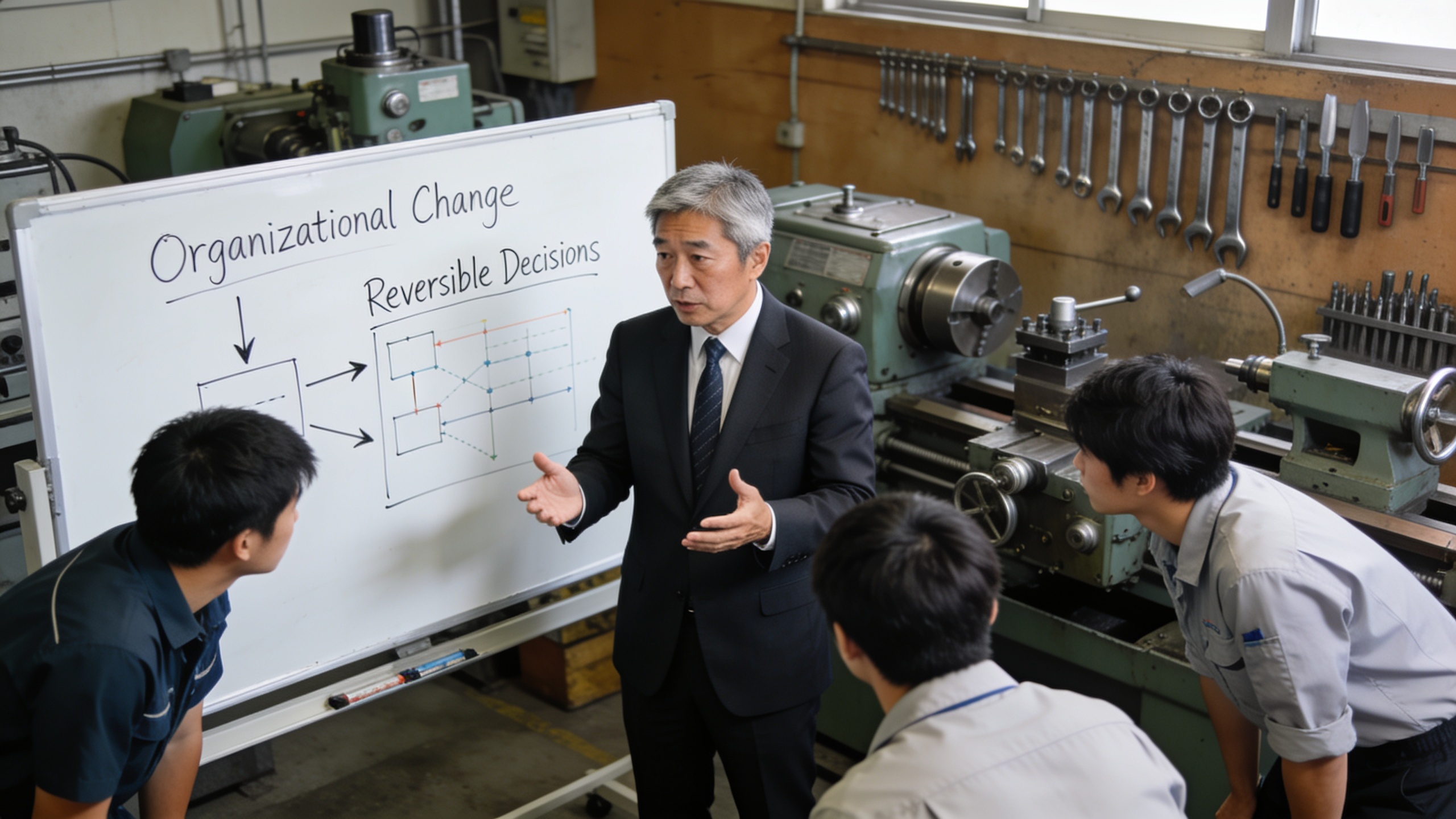
Why an 80% Market Share Legacy Manufacturer Embraced Transformation
A legacy manufacturer boasting an 80% market share took the bold step of pursuing organizational transformation. This case, reported by Persol Research and Consulting, offers valuable insights for many small and medium-sized enterprise (SME) leaders.
“You have the market share, so why change?” Some of you might wonder. However, this company’s decision is packed with the essence of “reversible management.”
Maintaining the Status Quo is the Greatest Risk
An 80% market share might seem rock-solid at first glance. Yet, as markets shift and talent becomes more fluid, maintaining the status quo slowly erodes competitiveness. Especially in SMEs, organizational structures that depend heavily on founders or key personnel risk sudden collapse due to a lack of successors or unexpected resignations.
This legacy manufacturer decided that precisely because its market share was high, “now is the time to change.” Missing the right moment for transformation could lead to an irreversible situation.
The Design Philosophy of “Reversible” Transformation
The key here is that the transformation was designed to be “reversible.” Many companies fail at change because once they start, they can’t turn back. Layoffs and organizational restructuring come with high costs to revert to the original state.
In this case, the company began by using a human capital management approach to create a system for “observing” employee skills and careers. Instead of making major organizational changes immediately, they first assessed the current situation and ran small experiments, minimizing the impact of potential failures.
Start Organizational Change with “Temporary Placements,” Not “Fixed Structures”
Here are specific methods for driving change in a “reversible” way.
Set an Evaluation Period
Always establish an “evaluation period” for any transformation. For example, when creating a new department or team, decide to review it after six months to a year. During this period, observe whether expected results are being achieved and if the workload on the team has increased.
Setting an evaluation period enables an experimental “let’s try it and see” approach. The peace of mind that comes from knowing you can revert if it fails encourages leaders to make decisions.
Clarify What to Observe
To judge the success or failure of a change, decide in advance what points to observe. Set multiple indicators beyond just sales and profit, such as employee engagement, turnover rates, and how dependent operations are on specific individuals.
As part of its human capital management, this legacy manufacturer visualized employee skill maps and career aspirations. This clarified which departments lacked certain talent and who could become future leaders.
Decide How Far to Revert in Case of Failure
The most important step is to decide in advance *how* to revert if things go wrong. If a new organizational structure doesn’t work, pre-plan which departments to restore and who to return to their original positions.
For example, if you abolish a newly created department, can its employees return to their original departments? If not, you must consider reassigning them to other departments or the risk of them leaving.
The Trap of 80% Market Share and the Importance of Reversibility
An 80% market share often obscures the “need for change.” A sense of satisfaction with the status quo and a resistance to change can spread throughout the organization.
The Danger of a Rigid Organization
Companies with high market share tend to cling to past successes. Consequently, many fail to adapt to new markets or technological shifts and decline rapidly.
Especially for SMEs, business models often rely on specific products or services, making it difficult to respond flexibly to market changes. Precisely because market share is high, management decisions should always be based on the assumption of “what if our share dropped by half.”
Three Key Points to Enhance Reversibility
To drive organizational change in a “reversible” way, keep these three points in mind.
1. **Focus on the Work, Not the People:** When problems arise, analyze “which business process is flawed” rather than “who is to blame.” Blaming people creates a climate of fear that hinders change.
2. **Prioritize Observation Over Fixation:** Instead of immediately making new systems or roles permanent, observe their actual impact on a limited-time or exceptional basis. Gather data before deciding on full-scale implementation.
3. **Design for Failure:** Define the evaluation period, exit conditions, and reversion plan *before* starting the change. This minimizes the damage if things go wrong.
Advice for SME Leaders
The case of this legacy manufacturer offers rich insights for SME leaders. Precisely because your market share is high, you must not miss the opportunity for change.
You Can Take on Challenges Because You Can “Revert”
One reason for hesitating to change is the fear of “what if I fail.” However, designing change to be “reversible” alleviates that anxiety.
For example, when exploring new sales channels, start with test marketing instead of a large initial investment. If results are good, expand; if not, withdraw. This “reversibility” encourages SMEs to take on challenges.
Now is the Time to Start “Observing”
The first step in transformation is observing the current state. How much does your organization and its business processes depend on specific individuals? If a key person suddenly quit, which operations would stop?
Visualizing these risks clarifies where to start. Then, design your countermeasures to be “reversible.”
Just as the legacy manufacturer with an 80% market share decided to change, now might be the right time for SME leaders to transform. However, please ensure that any change is always undertaken with the premise that it can be “reversed.”


Comments