What the Rakuten Bank Stock Plunge Reveals
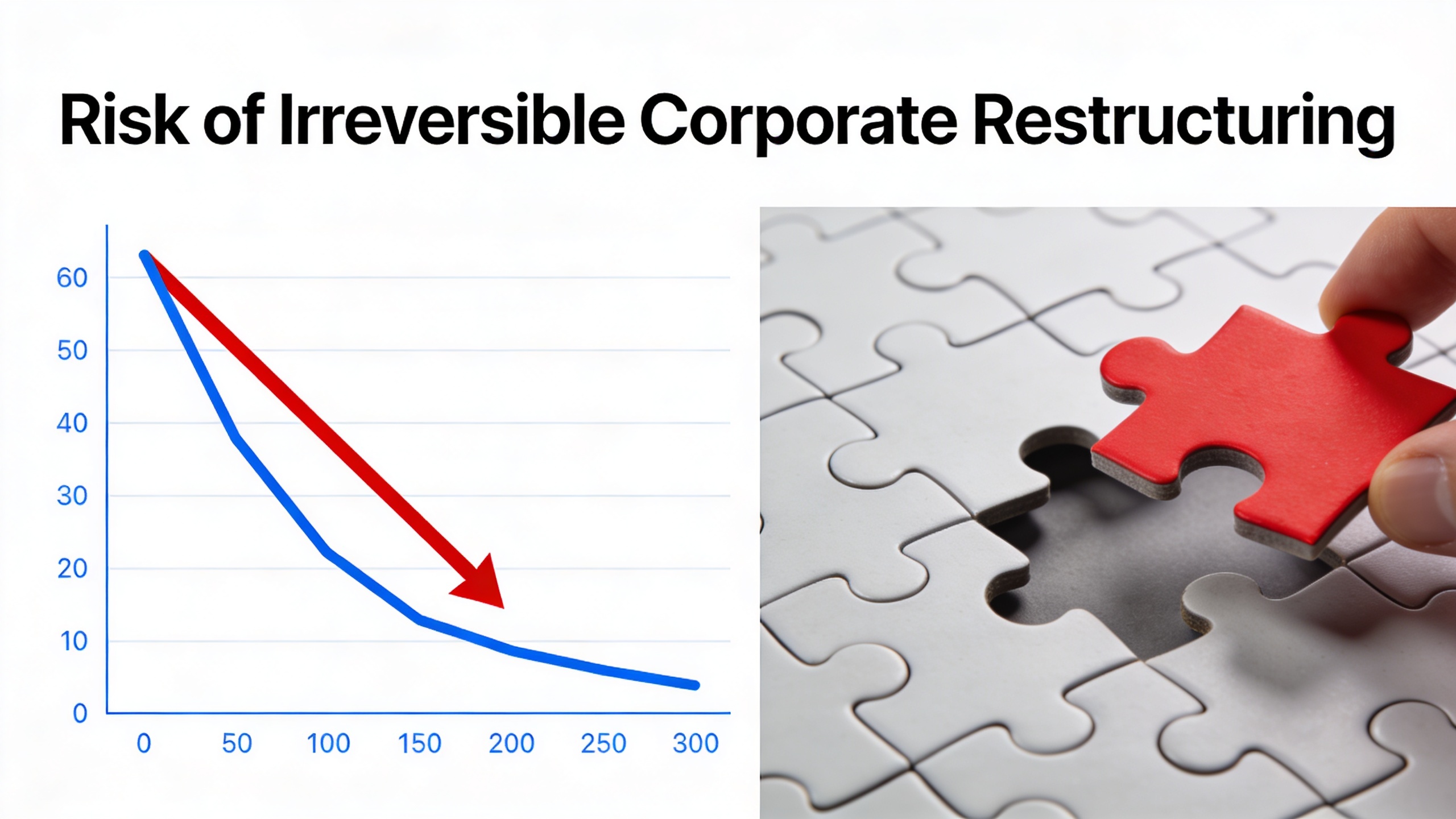
In December 2024, Rakuten Bank’s stock price hit its daily limit down, sending shockwaves through the market. The trigger was the parent company, Rakuten Group, announcing a restructuring of its financial business. Concerns over dilution from a third-party allotment of new shares prompted investors to sell.
Are you brushing this off as “just another big company story”? In reality, this event holds profound lessons for SME owners. Why? Because it lacked a “reversible management” design.
The Dilemma of Subsidiary Independence and Restructuring
Rakuten Bank is a publicly listed company. Being listed means there are minority shareholders. The parent company, Rakuten Group, decided to restructure its financial business to optimize the entire group. However, this decision came as a “surprise attack” to the subsidiary’s shareholders, triggering a sharp stock price decline.
The key question here is: “Was this restructuring designed to be reversible?” From a reversible management perspective, Rakuten Group’s restructuring had the following problems.
Three Factors That Destroyed Reversibility
First, **disregarding the subsidiary’s independence**. A listed subsidiary cannot be moved solely at the parent company’s convenience. A restructuring that ignores shareholder relationships damages market trust and creates an irreversible situation.
Second, **information asymmetry**. The intent and effects of the restructuring were not adequately communicated to the market, causing investors to react only to the negative aspect of “dilution.” The process of carefully explaining the “why” behind management decisions was missing.
Third, **the absence of exit conditions**. When proceeding with the restructuring, no scenario for “what to do if it doesn’t work out” was presented in advance. Markets dislike uncertainty. Without clear exit conditions or evaluation periods, investors overestimate risk.
Conditions for “Reversible Restructuring” That SME Owners Should Learn
Let’s apply this large-scale restructuring drama to SME management. For example, imagine you’re setting up a subsidiary to start a new business. Or, picture a scenario where you transfer shares to a successor as part of a business succession plan.
These decisions share the same structure as the Rakuten Bank case. Without a reversible design, you risk falling into an irreparable situation.
Condition 1: Set Evaluation Periods and Exit Conditions in Advance
Many business owners decide, “If the new business isn’t profitable in three years, we’ll pull out.” But what’s truly important is **setting specific triggers for exit**.
Predefine quantitative conditions, such as “Re-evaluate when sales fall below 80% of the plan” or “Consider downsizing if losses continue for six consecutive months.” This allows you to make decisions without being swayed by emotion.
Condition 2: Design Communication with Stakeholders
In Rakuten Bank’s case, insufficient communication with shareholders led to the stock price crash. SMEs also have various stakeholders: employees, business partners, financial institutions, and more.
When proceeding with restructuring or new ventures, it’s crucial to share with these stakeholders in advance: “Why are we making this decision?”, “What are the risks?”, and “What’s our plan if things don’t go well?” By ensuring transparency instead of dribbling out information, you can maintain trust.
Condition 3: Treat Subsidiaries and New Ventures as “Experiments”
The core of reversible management is viewing decisions as “experiments” rather than “final determinations.” When establishing a subsidiary, it’s important to adopt an attitude of “start small and test hypotheses.”
Instead of pouring in large resources from the start, begin with minimal investment and expand based on results. This minimizes the damage if things fail. Rakuten Bank’s restructuring was a large-scale move that was difficult to reverse once decided. SMEs, in particular, should adopt a “reversible approach” of accumulating small experiments.
The True Stability Brought by “Reversible Management”
The recent Rakuten Bank news highlighted a problem that became visible because it’s a listed company, but the essence is common to businesses of all sizes.
Management decisions are often thought to be irreversible once made. But that’s not true. What matters is **not making flawless decisions, but creating a system that allows you to recover from them**.
“Reversible management” is not a sign of weakness. Rather, it’s a mature form of management that faces reality, controls risks, and moves forward.
Viewing Exit as “Learning,” Not “Defeat”
It’s still unclear how Rakuten Group’s restructuring will ultimately play out. However, if it doesn’t go as planned, the backlash from the market and shareholders will likely be even greater.
For SME owners, exiting is often seen as “defeat.” But I don’t think so. Exiting is a valuable opportunity for “learning.” By analyzing why you failed and where you lost reversibility, your next decision will be better.
Starting Your “Reversible Design” Today
So, where should you start concretely?
First, list your current projects and new ventures. Then, try answering the following questions for each one:
* Under what conditions and when can this decision be reversed?
* If reversed, how much cost and time would it take to return to the original state?
* Do all stakeholders understand that this decision is an “experiment”?
Decisions that cannot be clearly answered for these questions have low reversibility. Start by designing “room to return” into each decision.
The Rakuten Bank stock plunge is by no means someone else’s problem. It is a wake-up call to us, SME owners, to **design “reversible management.”**

Comments