- The Moment You Say “I’ve Decided,” You Can’t Go Back
- The Shift in Thinking: “Provisional Placement”
- Why “Provisional Placement” Works
- Three Rules for Practicing “Provisional Placement”
- Recognizing the Trap of “Fixing”
- “Provisional Placement” Transforms Organizations
- “Reversible Management” Is a Series of “Provisional Placements”
The Moment You Say “I’ve Decided,” You Can’t Go Back
The moment you decide, “Let’s go this way,” many business leaders feel relief. But haven’t you experienced that relief turning into the pressure of “I can’t turn back now”?
In business decision-making, the most dangerous thing isn’t the decision itself. It’s closing off the possibility of verification the moment you decide. The thought, “I’ve decided, so I have to do it,” is the biggest factor that makes decisions irreversible.
I’ve observed many business leaders over the years, and the best ones treat “decisions” lightly. They don’t see decisions as “final conclusions” but as “temporary placements.”
The Shift in Thinking: “Provisional Placement”
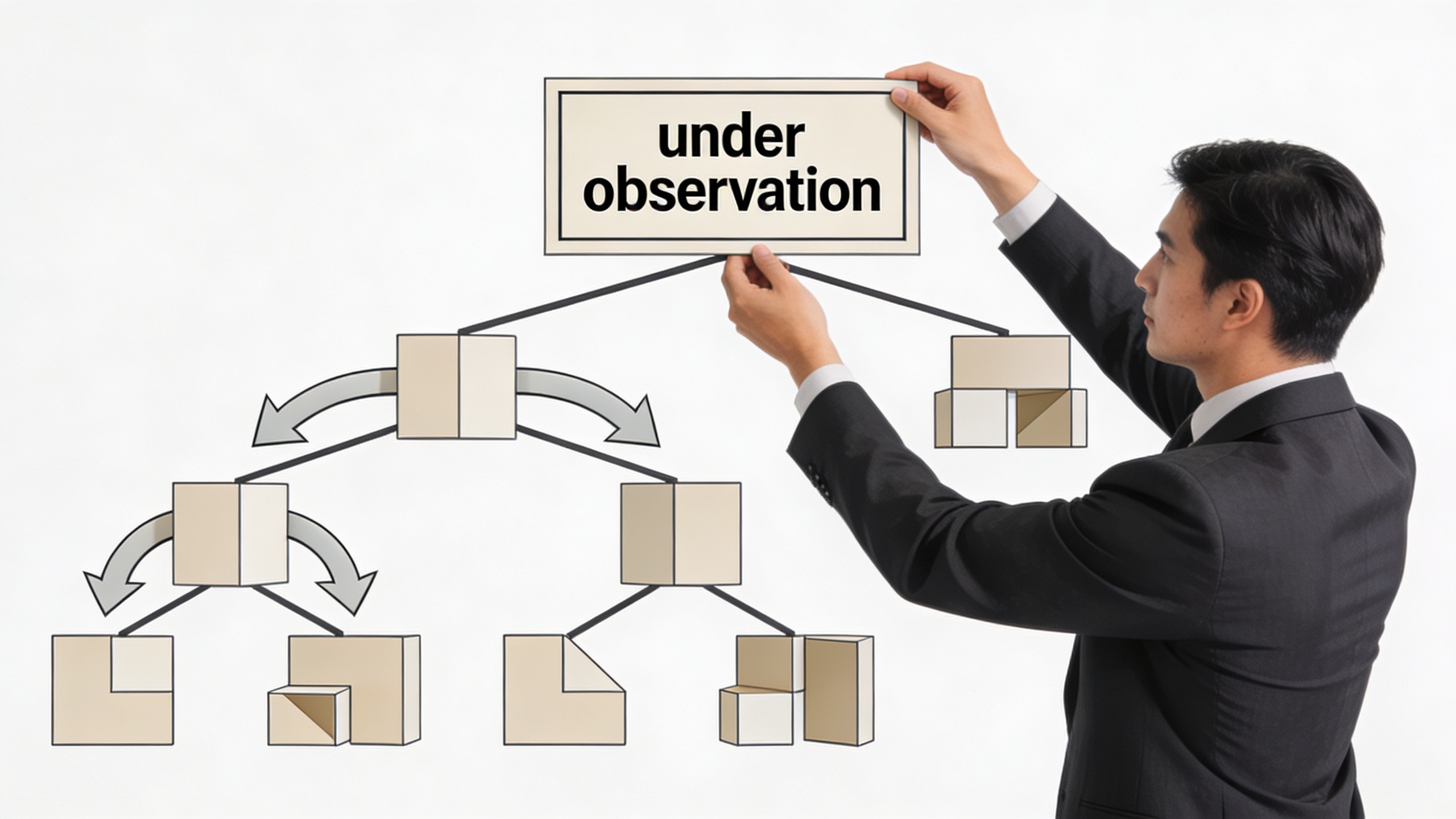
“Provisional placement” means temporarily holding off on a decision and leaving it in a state where it can be observed. Instead of fixing it, you set an evaluation period and verify the decision with data gathered during that time.
For example, consider starting a new business. Many leaders think in terms of “do it or don’t.” If they decide “do it,” they immediately assign staff, allocate a budget, and rent an office. At that point, the cost of withdrawal balloons, and psychologically, they feel trapped into “can’t back out.”
But with the “provisional placement” mindset, you could first try it for three months with existing team members working part-time. No dedicated staff, minimal budget, no office rental. In this state, the cost of withdrawal is extremely low, and psychological resistance is minimal.
I personally learned the importance of “provisional placement” the hard way in a past venture. When starting a new business, I thought, “If we’re doing it, let’s go all in,” and assembled a dedicated team from the start with a large budget. The result was a complete failure. By the time we needed to withdraw, the team was already in motion and the budget was spent. If we had started with “provisional placement,” we could have pulled out early.
Why “Provisional Placement” Works
The reason “provisional placement” works lies in human cognitive bias. Once we decide, we start gathering only information that justifies that decision. This is called “confirmation bias.”
From the moment you decide “let’s do it,” your brain starts searching for “reasons to do it.” Market data is interpreted optimistically, and risks are underestimated. In this state, you can’t make sound judgments.
However, in a “provisional placement” state, you haven’t decided yet. You’re just “observing.” In this state, you can evaluate data neutrally. Negative information like “response is weaker than expected” or “costs are higher than anticipated” can be accepted calmly.
In other words, “provisional placement” is a mechanism to neutralize your cognitive biases.
Three Rules for Practicing “Provisional Placement”
So, how do you actually practice “provisional placement”? Follow these three rules.
Rule 1: Set the Evaluation Period First
The most important thing in “provisional placement” is to decide the evaluation period upfront. Decide in advance: “We’ll judge in three months” or “We’ll verify in six months.” During this period, you don’t fix anything; you simply “observe.”
If you say “let’s see how it goes” without setting an evaluation period, you’ll keep postponing the decision and eventually find yourself in a state where withdrawal is impossible. Setting a deadline forces you to create a timing for judgment.
Rule 2: Decide What Indicators to Observe
Along with the evaluation period, decide what to observe. Use objective indicators like “sales,” “number of customers,” or “number of inquiries.” The key is to use measurable numbers, not subjective “feelings.”
Feelings like “it seems okay” or “it doesn’t seem bad” are infected by confirmation bias. Always set indicators that can be judged by numbers.
Rule 3: Decide Withdrawal Conditions in Advance
This might be the hardest, but it’s the most important. Decide in advance: “If this indicator falls below XX, we withdraw.” By setting withdrawal conditions, you can judge by rules, not emotions.
Emotions like “there’s still a chance” or “if we try a little harder” are the most dangerous for business leaders. If you decide withdrawal conditions in advance, you can withdraw calmly without being swept away by those emotions.
Recognizing the Trap of “Fixing”
One trap business leaders often fall into is “fixing.” When you hire someone, you fix them as “the person to handle this.” When you create a system, you fix it as “this is the rule.” When you introduce a tool, you fix it as “let’s unify with this system.”
But this “fixing” is the biggest factor that makes decisions irreversible. Before fixing, always set a “provisional placement” period. Start with people working part-time, introduce systems on a trial basis, and test tools in only a few departments.
Fixing should only happen after you understand the actual situation. If you fix without understanding the reality, it’s nothing more than a gamble.
“Provisional Placement” Transforms Organizations
The concept of “provisional placement” can also be applied to the entire organization. View the organization as a place for “experiments,” not “decisions.”
For example, when creating a new department, don’t launch it as a formal organization from the start. Instead, “provisionally place” it as a project team. Set an evaluation period, and if results are confirmed, upgrade it to a formal department. With this approach, the damage from failure is minimized.
In one of my client companies, a new business started with “provisional placement” and decided to withdraw after three months. If they had launched it as a formal organization from the start, they would have invested heavily in staff and budget, and withdrawal would have taken over a year. But because it was “provisional placement,” the cost of withdrawal was minimal. From this experience, the leader learned the importance of not rushing decisions.
“Reversible Management” Is a Series of “Provisional Placements”
“Reversible management” isn’t about making perfect decisions. It’s about repeatedly placing decisions “provisionally,” observing, verifying, and, if necessary, reversing course.
There are no “right answers” in business decisions. But by introducing the mechanism of “provisional placement,” you can minimize the damage when you’re wrong. And from those small failures, you can learn and apply that knowledge to your next decision.
Why not start “provisional placement” in your company today? Begin by setting an “evaluation period” and “withdrawal conditions” for your next business decision. Just that alone will make your decisions significantly more “reversible.”

Comments