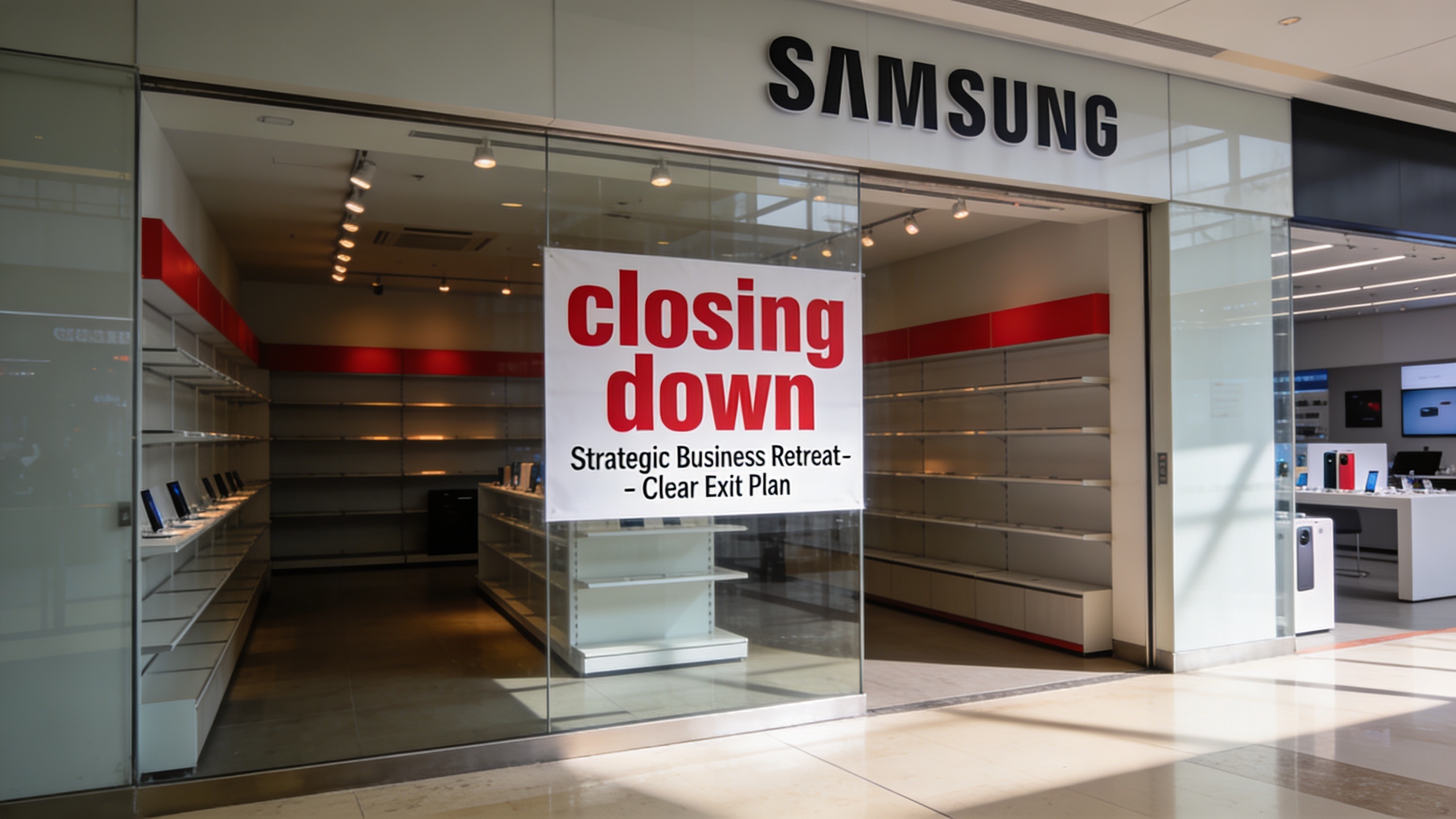
Samsung to Exit Home Appliance Sales in China
Samsung Electronics has decided to withdraw from selling home appliances in the Chinese market, primarily due to declining profitability. The company plans to gradually phase out sales of major products like TVs, refrigerators, and washing machines, eventually exiting the market entirely.
Global companies leaving China is not unusual these days. However, Samsung’s decision holds a valuable lesson for small and medium business owners: whether they set exit conditions in advance.
Samsung had operated its home appliance business in China for years, but profitability deteriorated due to the rise of local competitors and intensifying price wars. The key question is why they chose this particular timing to exit.
Most likely, Samsung had pre-set conditions like “if profitability drops below this level, we exit.” Or they closely monitored market changes and identified the right moment to act.
Designing a “Reversible Exit”
Many SME owners don’t think about exit strategies when launching new ventures or entering new markets. Honestly, they probably don’t want to. But from a “reversible management” perspective, setting exit conditions in advance actually enables bolder challenges.
What does setting exit conditions in advance mean in practice?
Set an Evaluation Period
First, decide when to evaluate results before starting a business. For example, “if we’re not profitable within three years, we exit.” This condition allows you to make a calm, objective decision after three years, without being swayed by emotions.
In Samsung’s case, their home appliance business in China had likely been underperforming for years. The reason they decided to exit now is probably because they had some evaluation period in place. Without one, you’d keep saying “let’s wait a little longer” indefinitely.
Quantify Exit Conditions
Next, define exit conditions with specific numbers. For instance, “if sales drop by X%,” “if operating profit margin falls below X%,” or “if cumulative losses reach $X.”
The key is to make the criteria objective. Instead of a vague “it feels tough,” set a clear standard that anyone can see and agree “this is the time to exit.”
Plan the Exit Process in Advance
Decide how to wind down the business before you even start. Consider inventory disposal, employee treatment, notifying partners, and contract termination terms.
Reports say Samsung will phase out sales in China gradually. This is a method that preserves reversibility rather than exiting all at once. Instead of closing all stores immediately, they stop sales at some locations, observe reactions, and then take the next step. This is one form of a “reversible exit.”
Why Can’t Many Business Owners Set Exit Conditions?
There are three main reasons why many business owners fail to set exit conditions in advance.
Optimism Bias
First is optimism bias. The belief that “I’ll be the one who succeeds” or “if I try a little harder, things will work out” prevents setting exit conditions.
But in business, there are no absolutes. No matter how much you prepare, unexpected events happen. That’s exactly why you need to design for failure.
Psychological Cost of Exiting
Second is the psychological cost. Exiting is often seen as “defeat,” hurting the owner’s pride and reputation. This is especially true for businesses you started yourself or have been involved with for years.
But exiting isn’t defeat. It’s a strategic decision to use resources more effectively. By exiting, you can focus on new opportunities.
Delaying Evaluation
Third is postponing evaluation. Saying “let’s wait a little longer” delays the decision and causes you to miss the exit window. As a result, losses grow and the situation becomes irreversible.
Setting an evaluation period and a rule to make a decision at that time prevents this delay.
Benefits of Setting Exit Conditions
Setting exit conditions in advance offers several advantages.
Lower Barrier to Challenge
Knowing “if I fail, I can exit by this point” creates peace of mind. This lowers the barrier to taking on new ventures or entering new markets.
The essence of “reversible management” is turning decisions into experiments. Experiments have pre-set evaluation periods and exit conditions. This allows you to challenge without fear of failure.
Focusing Management Resources
Setting exit conditions prevents you from pouring resources into unprofitable businesses indefinitely. You can avoid missing the exit timing and concentrate resources on more promising areas.
For Samsung, exiting China’s home appliance market allows them to focus on more profitable or future-oriented fields. This is one purpose of the exit decision.
Organizational Learning
By setting and executing exit conditions, the organization learns a lot. Why didn’t it work? What was missing? What could have been done differently? These lessons can be applied to the next challenge.
Exiting isn’t failure; it’s a learning opportunity. Structuring failure and accumulating it as organizational wisdom is another aspect of “reversible management.”
Summary
Samsung’s exit from China’s home appliance market is one strategic decision by a global company. But behind it lies the essence of management: setting exit conditions in advance and exiting at the right time.
For SME owners, setting exit conditions in advance isn’t difficult. Before starting a new venture, decide on an evaluation period and exit conditions. That alone lowers the barrier to challenge and controls the risk of failure.
“Reversible management” is not about running away. It’s a strategy for actively taking on challenges. Set exit conditions first, stay calm, and make objective decisions. That’s the first step toward sustainable management.


Comments