- Turning Anniversary Projects into Experiments for Organizational Change
- Building an Organization That Can Challenge Because It Can “Go Back”
- Three Design Points to Ensure Reversibility
- Avoiding Failure in Organizational Change Through Anniversary Projects
- What “Reversible Management” Brings to an Organization
- Summary: Make Your Anniversary Project the First Step Toward a “Reversible Organization”
Turning Anniversary Projects into Experiments for Organizational Change
Company anniversary projects. Many executives think, “We want to make this milestone exciting” and “We want to show our presence both inside and outside the company,” while also hesitating, “It takes too much time and cost to prepare” and “It puts too much burden on the person in charge.”
Recently, Tocasi announced the launch of its “accompanied anniversary project support” service. The idea of connecting anniversary projects not just to a commemorative event but to organizational change and challenges for the next generation—this concept hits the core of “reversible management.”
Why? Because anniversary projects are extremely effective as an “experimental lab” for organizational change. Unlike regular business transformations, they have a limited timeframe and are easy to revert to the original state if they fail. In other words, they have high reversibility.
Building an Organization That Can Challenge Because It Can “Go Back”
In management decisions, there are those with high reversibility and those with low reversibility. Large investments in new businesses or organizational restructuring are difficult to reverse once started. But anniversary projects are different.
Anniversary projects have the following three characteristics:
- Clear deadline: The event day is the goal. After that, you can enter an evaluation period.
- Limited scope: It can be treated as a specific project, not a company-wide transformation.
- Low cost of failure: In the worst case, you can cancel the event and return to the original state.
By leveraging this “reversible” characteristic, you can use anniversary projects as a “temporary setup” for organizational change. New team structures, new workflows, new evaluation systems—you can test these within the limited framework of an anniversary project, observe the effects, and then decide whether to fully implement them.
Practical Example: Testing a New Organizational Structure with an Anniversary Project
In a small to medium-sized company I consulted for, they piloted a “project-based organization” for their 50th anniversary. Instead of the usual siloed structure, they formed a cross-functional team to prepare for the anniversary project. Members from different departments gained experience collaborating together.
As a result, the anniversary project was a success. More importantly, they gained confidence that “cross-departmental collaboration is possible.” They then proceeded with a full-scale organizational restructuring.
Even if this attempt had failed, they could have simply reverted to the original organization after the anniversary project ended. It was truly a “reversible” design.
Three Design Points to Ensure Reversibility
To use anniversary projects as an experimental lab for organizational change, you need to incorporate the following three points into the design.
Clearly Set an Evaluation Period
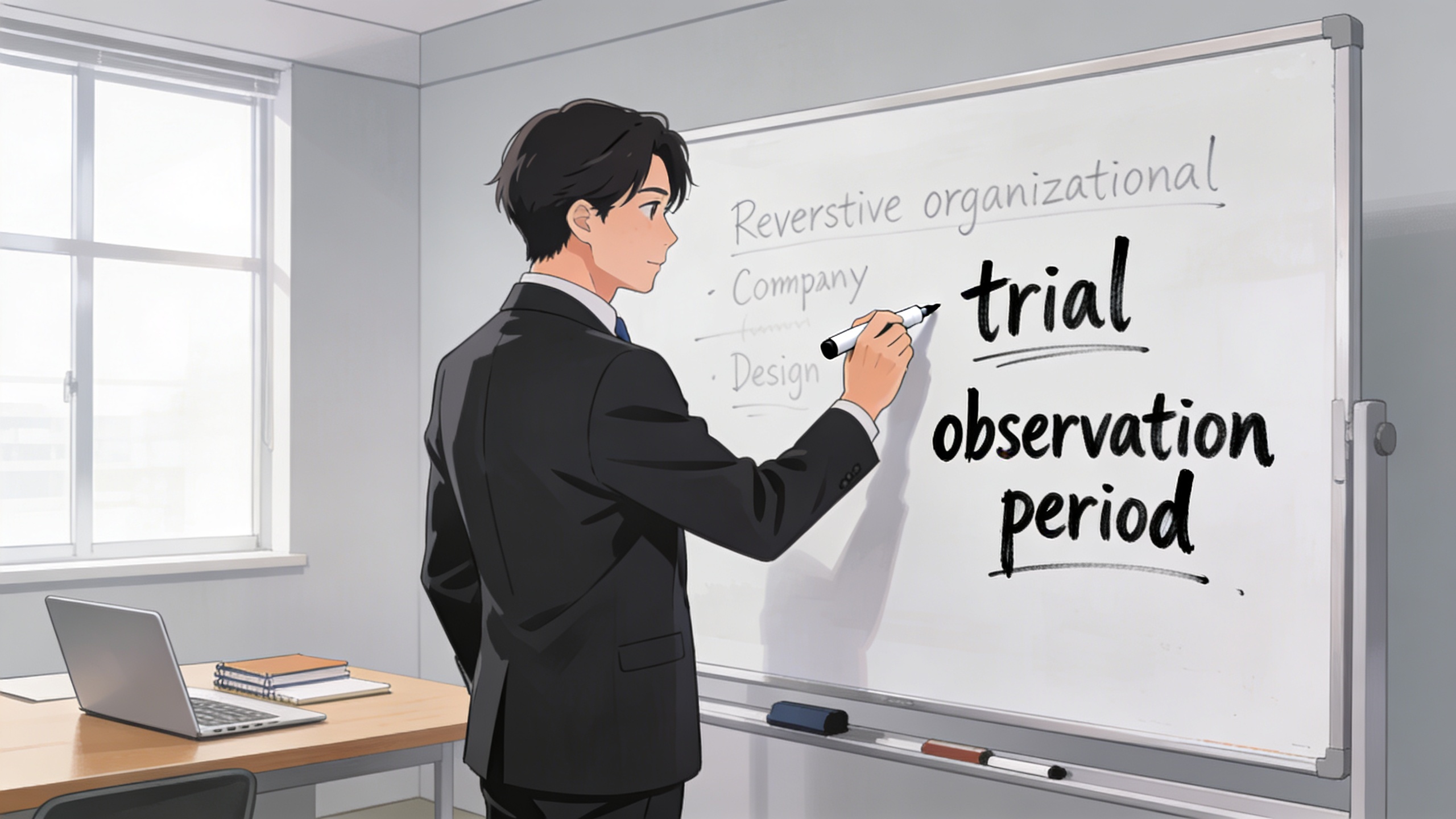
Decide in advance that “after the anniversary project ends, we will definitely take time for reflection.” Set aside a period to evaluate not just whether it succeeded or failed, but “whether this initiative is worth full-scale implementation.” A period of 1 to 3 months is a good guideline.
Decide What to Observe in Advance
Determine “what we need to observe to judge the effectiveness of this initiative” before the project starts. For example, if you’re testing a new team structure, set indicators like “frequency of cross-departmental information sharing,” “speed of decision-making,” and “member satisfaction.”
Plan How to Revert in Case of Failure
Decide in advance “how to revert to the original state if this initiative doesn’t work out.” This is the core of “reversible management.” For an anniversary project, clarify rules like “revert to the original organizational structure immediately after the event ends” and “team members return to their original departments.”
Avoiding Failure in Organizational Change Through Anniversary Projects
If you approach anniversary projects without the “reversible management” mindset, you’re likely to fall into the following pitfalls.
- Overly ambitious goal setting: Setting unrealistic KPIs like sales targets or new customer acquisition numbers for a commemorative event.
- Excessive burden on the person in charge: The person in charge burns out from juggling regular work and the anniversary project.
- A culture of hiding failure: The pressure to “make it a success at all costs” for a commemorative event leads to hiding problems.
All of these problems stem from the assumption that “you can’t go back.” Conversely, if you accept that “you can go back,” you can shift your thinking as follows.
- Declare in advance: “This is an experiment, so it’s okay to fail.”
- Decide: “We will monitor the person in charge’s workload and stop immediately if it exceeds their limits.”
- Share: “Our top priority is to extract learnings from the reflection process.”
What “Reversible Management” Brings to an Organization
Not just for anniversary projects, but for all management decisions, a “reversible” design is essential. Why? Because the future is unpredictable, and no matter how much you prepare, unexpected events will happen.
Designing for “reversibility” brings the following benefits.
- Lowers the barrier to challenge: If you can go back after failure, it’s easier to try new things.
- Promotes learning: By experimenting without fear of failure, you gain valuable experience and insights.
- Increases organizational adaptability: An organizational culture that can flexibly respond to change is cultivated.
Tocasi’s initiative puts this “reversible management” concept into practice in the concrete form of anniversary projects. Providing an “experimental lab” for organizational change, not just commemorative event support—this perspective offers valuable insights for many small and medium-sized business owners.
Summary: Make Your Anniversary Project the First Step Toward a “Reversible Organization”
Anniversary projects are a perfect opportunity for organizational change. However, if you view them as a “must-succeed major project,” you’ll end up feeling constrained.
From the perspective of “reversible management,” anniversary projects are “experiments where failure is acceptable.” Because they are time-limited and scope-limited, you can make bold challenges. By connecting that experience to the next step, your organization will steadily grow.
Why not make your company’s next anniversary project the first step toward building a “reversible organization”?


Comments