
- The Essence of “Reversible Transformation” Learned from Sony’s V-Shaped Recovery
- The Intersection of Kotter’s Theory and Reversibility
- Conditions for a “Reversible Organization” as Taught by Neuroscience
- Three Principles for Designing a “Reversible Organization”
- Summary: The “Reversible Design” Behind the V-Shaped Recovery
The Essence of “Reversible Transformation” Learned from Sony’s V-Shaped Recovery
It has been reported that the background to Sony’s astonishing V-shaped recovery involved Kotter’s theory and a neuroscience-based approach. While many media outlets focus on the “heroes of the revival” or “key success factors of the reform,” I would like to interpret this news from a different perspective.
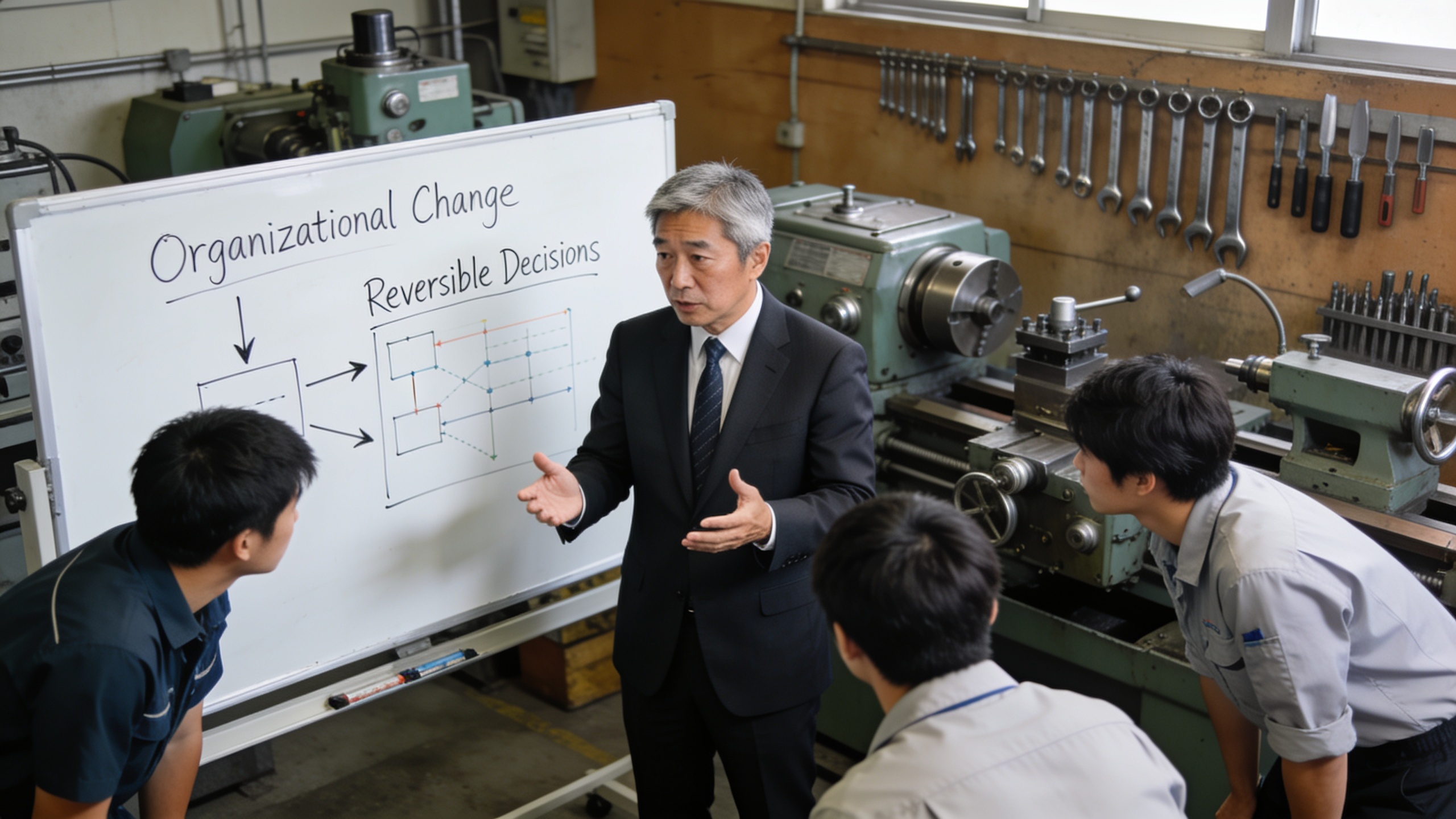
That perspective is “reversible management decisions.” Sony’s transformation appears, at first glance, to be a series of bold and irreversible decisions. However, in reality, wasn’t a design of reversibility—”testing hypotheses while leaving room to backtrack”—embedded throughout?
For SME owners, the transformation of a giant corporation might seem like a story from a distant world. However, the “principles of reversible transformation” that can be extracted from Sony’s case are applicable regardless of scale.
The Intersection of Kotter’s Theory and Reversibility
Kotter’s 8-step change process has been adopted by many companies. However, the true essence of this theory lies not in “following the steps,” but in “creating mechanisms to revert at each step.”
The Misunderstanding of “Achieving Results Quickly”
A common misunderstanding of Kotter’s theory is the “short-term wins” stage. Many executives pressure their teams to “produce results as quickly as possible.” However, this is a major pitfall.
Rushing for short-term wins by forcing through layoffs or aggressive reorganizations makes it impossible to turn back. What Sony did was an approach of repeating small experiments and only fully rolling out those whose effectiveness was confirmed.
From a neuroscience perspective, humans show strong resistance to forced change. Sony presented change as an “option” to prevent their employees’ brains from triggering a rejection response. This is the core of “reversible transformation.”
Conditions for a “Reversible Organization” as Taught by Neuroscience
The human brain experiences strong stress in response to uncertainty. On the other hand, it doesn’t grow in a completely predictable environment. “Reversibility” is what resolves this dilemma.
The “Reassurance of Being Able to Revert” Encourages Challenges
What is particularly noteworthy about Sony’s transformation is the cultivation of a culture that tolerates failure. Employees were able to actively participate in new initiatives precisely because they felt, “Even if this reform doesn’t work out, we can go back to how things were.”
To achieve this in an SME, the following three points are crucial.
1. Set an “evaluation period” for the change in advance.
2. Decide on the “exit conditions” before starting.
3. Create a procedure manual for “how to revert.”
By deciding these things in advance, employees gain the psychological safety of knowing “it’s okay even if we fail.”
The Method of Accumulating Small Experiments
Sony didn’t attempt a massive transformation all at once. They started new initiatives in a specific department, observed the results, and gradually expanded the scope.
The advantage of this method is that even if it fails, the damage is limited. Also, even if it succeeds, you can analyze “why it succeeded” when rolling out the knowledge to other departments.
What I recommend for SME owners is to start a new initiative with just “one project” or “one team.” Trying to push through company-wide change all at once leads to accumulating irreversible decisions.
Three Principles for Designing a “Reversible Organization”
Let’s translate the design principles for a “reversible organization” extracted from Sony’s case for SMEs.
Principle 1: Embed Reversibility in Work, Not People
A common mistake many companies make is making the success or failure of a change dependent on a specific leader or key person. Sony built a system that could revert even if people changed by embedding reversibility into organizational structures and work processes.
In SMEs, “person-dependency”—where only one person can do a task—often becomes a problem. However, person-dependency is a breeding ground for irreversible decisions. It’s important to break down tasks and design processes that produce the same results regardless of who handles them.
Principle 2: Establish an Observation Period Before Making Things Permanent
When introducing a new system or tool, don’t start full-scale operations immediately. First, set up a “trial operation” period. Sony also positioned all new initiatives as “experiments,” verifying their effectiveness before full-scale implementation.
What’s important during this observation period is to decide in advance what to measure. Set multifaceted indicators such as “employee satisfaction,” “work efficiency,” and “error rate,” not just “sales” or “profit.”
Principle 3: Decide Exit Conditions First
This is the most important principle. Before starting a new initiative, decide “under what conditions we will exit.” It is said that Sony also set clear exit criteria for each project.
By deciding exit conditions, you can make judgments without being swayed by emotions. Also, if the conditions are not met, the option to “continue” remains. This is the true essence of “reversible management.”
Summary: The “Reversible Design” Behind the V-Shaped Recovery
Sony’s V-shaped recovery is not merely the result of “strong leadership” or “bold reform.” Behind it was a meticulous design that always left “room to revert” while moving forward.
For SME owners, when driving change, always consider, “If we fail, how far can we revert?” By securing a path back, you can actually make bolder challenges possible.
“Reversible management” is by no means timid management. Rather, it is the wisest approach for facing reality and achieving sustainable growth.

Comments