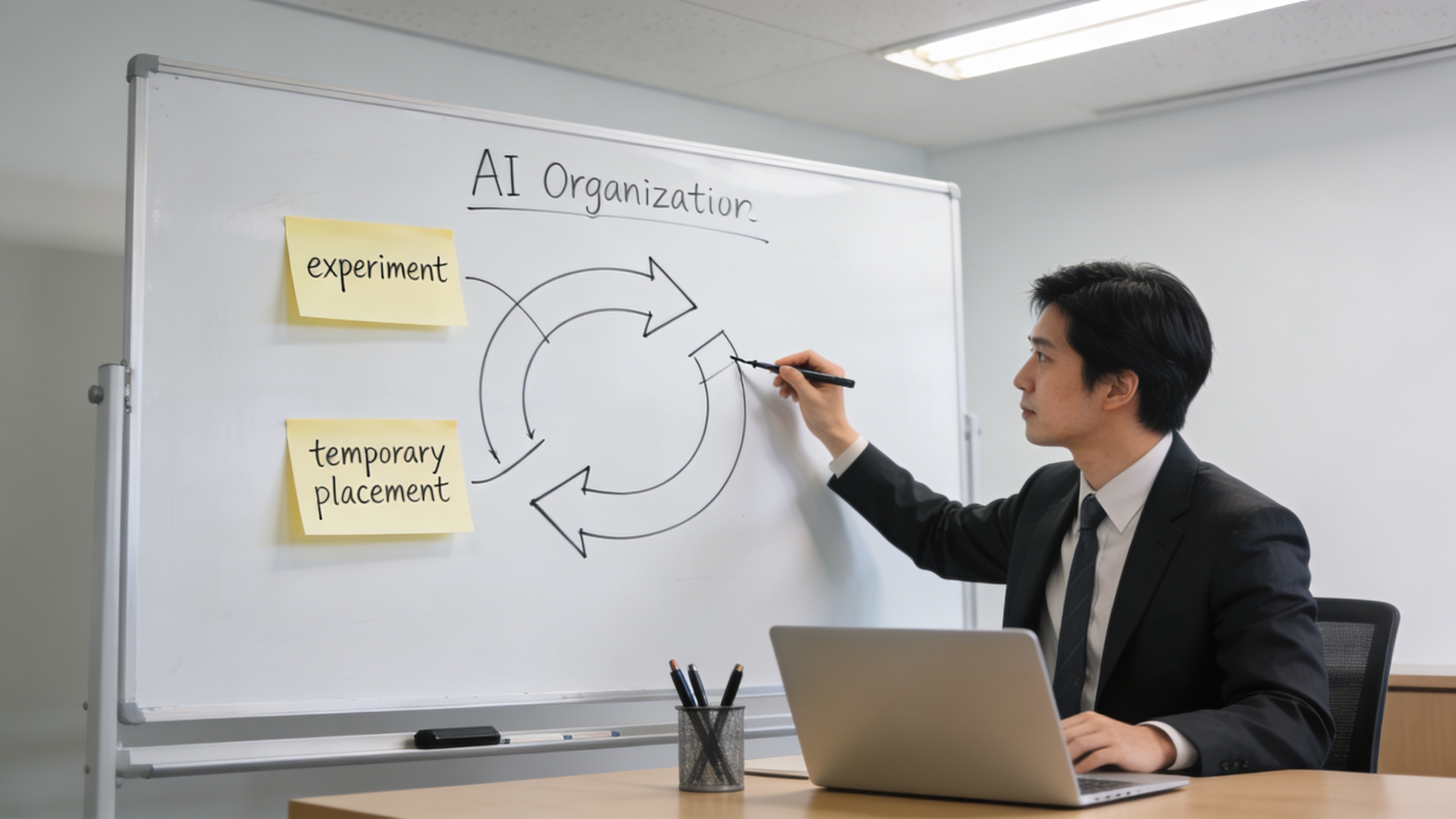
The Concept of “Temporarily Placing” a Specialized Team
News has arrived that NEWh has established a new cross-functional specialized team, the “AI Innovation Node,” to support organizational transformation and new business development using AI. Leveraging AI is an urgent challenge for many small and medium-sized enterprises. However, what I want business owners to consider here is one key point: “How should we position this team?”
Many executives, when creating a new specialized team, tend to instinctively think of it as a permanent fixture. But from the perspective of “reversible management,” I’d like to offer a different approach: design such a specialized team as a “temporary placement.”
As the name “AI Innovation Node” suggests, this team is expected to function as a node—a flexible, variable unit rather than a fixed department. This very idea is the essence of “reversible management.”
What Happens When You Fix a Team in Place
The risk of fixing a team in place is that it becomes extremely difficult to reverse course. For example, suppose you launch an AI-specific department as a formal division, headhunt top talent, and introduce dedicated systems. But six months later, if the expected benefits of AI prove weaker than anticipated, can you make the decision to shut down that department?
Many executives end up maintaining clearly underperforming teams because of reasons like “we’ve already built it,” “we’ve brought in excellent people,” or “we’ve invested in it.” This is a classic example of “irreversible management.” I myself have experienced selling off unprofitable businesses in the past, and the psychological cost of getting to that point was substantial.
When you fix a team in place, the careers and expectations of the people working there also become fixed. Abolishing a department isn’t just an organizational change—it can alter people’s lives. That’s why it’s crucial to design it as a “temporary placement” from the start.
Learning Reversible Design from the “AI Innovation Node”
The key point about NEWh’s “AI Innovation Node” is that it’s a cross-functional specialized team. This means it doesn’t belong to any specific department, and members gather flexibly for each project. This design incorporates reversibility in the following ways:
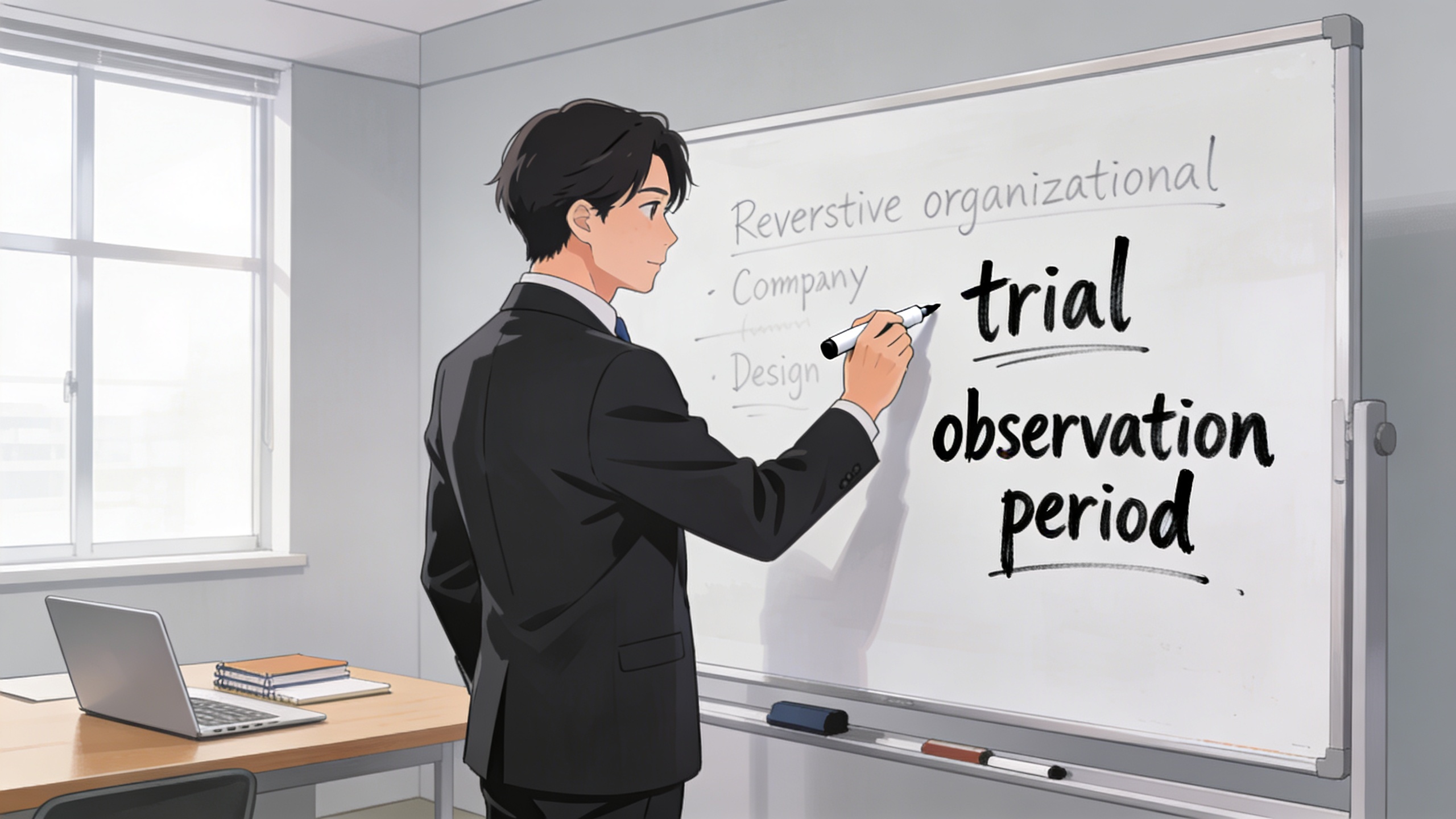
First, members’ affiliations aren’t fixed. When a project ends, they can return to their original departments. This ensures a “reversible career.” Second, the evaluation period for the team can be set short-term. By deciding upfront that “we’ll judge the results of this project in three months,” it becomes easier to make the call to withdraw.
Third, budget and resource allocation can be done in stages. Instead of making a large investment from the start, begin with a small-scale experiment, confirm the effects, and then scale up. This is a fundamental principle of “reversible management.”
Set the Evaluation Period First
So, how exactly should you design this? First, decide on the evaluation period in advance. Clearly state at the launch, “We’ll judge the results of this AI specialized team in six months.” Then, prepare three options at that point: “continue,” “downsize,” or “abolish.”
Many executives create a team with a casual “let’s just try it” attitude, only to find that three years have passed without realizing it. By setting the evaluation period upfront, you create regular opportunities to make the decision to “return.”
Fix the Work, Not the People
Another key point is the idea of “fixing the work, not the people.” In a cross-functional team like the “AI Innovation Node,” design the work so that anyone can handle it, rather than relying on specific individuals. This ensures organizational continuity even when the person in charge changes.
Conversely, a team that depends on a particular super-engineer will become dysfunctional the moment that person leaves. This is a classic example of an “irreversible team.” It’s important to standardize and manualize tasks so that personnel changes don’t affect the team’s survival.
“Temporary Placement Teams” Are Especially Effective for SMEs
Unlike large corporations, small and medium-sized enterprises don’t have surplus resources. Creating the wrong team can directly impact your business. That’s why a “reversible” design is essential from the start.
For example, when launching an AI utilization project, first recruit volunteers from among your existing employees and start with them working on it as a secondary role. By not making it a dedicated team, if the results are poor, they simply return to their original duties. This minimizes both personnel costs and psychological costs.
My past experience with establishing and then withdrawing from a Malaysian subsidiary would not have led to the decision to withdraw without this “temporary placement” mindset. The principle of “start small and clarify the conditions for withdrawal” can be applied to organizations of any size.
Set Withdrawal Conditions in Advance
Before launching a team like the “AI Innovation Node,” I recommend setting withdrawal conditions in advance. Examples include specific criteria like “dissolve if monthly sales don’t reach $7,000 (approx. 1 million JPY) within six months” or “downsize if at least three viable use cases aren’t found within three months.”
The biggest advantage of setting withdrawal conditions is that you can make decisions without being swayed by emotions. Instead of wishful thinking like “there might still be a chance,” you judge based on pre-determined numbers. This is the core of “reversible management.”
Summary: Treat Your Team as an Experiment
What we should learn from NEWh’s “AI Innovation Node” is the attitude of treating a specialized team as an experiment. Experiments can succeed or fail. What matters is how quickly and at how low a cost you can return to the starting point if it fails.
Don’t fix your team in place—design it as a temporary placement. Set the evaluation period first. Fix the work, not the people. Set withdrawal conditions in advance. By following these principles, you can confidently start new initiatives like AI utilization.
“Reversible management” isn’t about never failing; it’s about being able to recover from failure. When creating a new team, always ensure you have a “way back.” In the long run, that’s the smartest management decision.
Comments