
Exit While You Can, Even After a Glorious Start
News recently broke that OpenAI has decided to withdraw from Sora, its AI video generation service. Sora was a groundbreaking tool that could create high-quality videos from text, generating massive buzz even before its release. Many experts hailed it as a technology that would “change the future of video production.”
However, contrary to those expectations, OpenAI pivoted to a strategy prioritizing practicality and profitability, choosing to exit Sora.
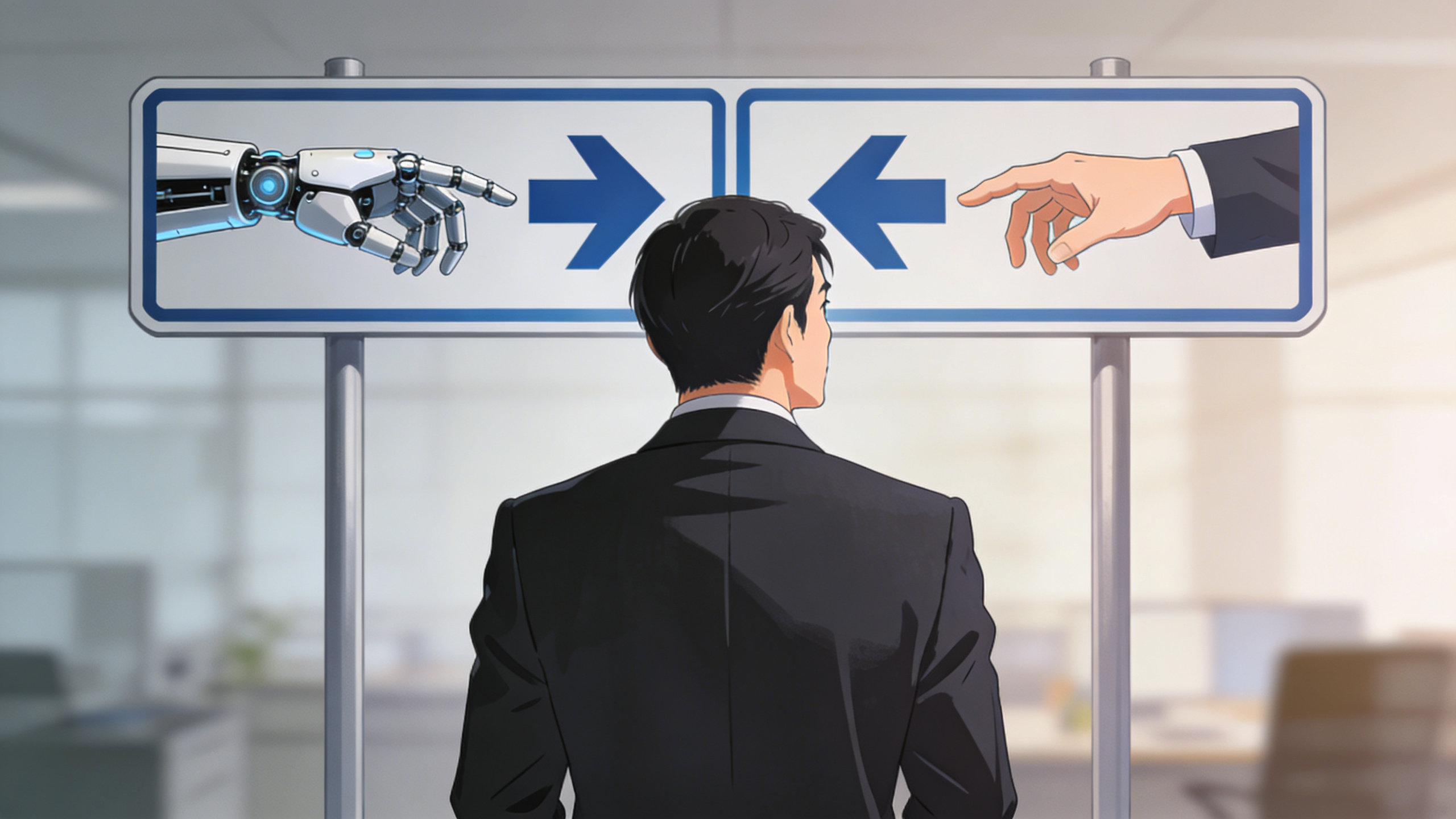
This news holds profound lessons for us, the owners of small and medium-sized enterprises (SMEs). Even a new business that starts with a bang, or a new system introduced with high hopes for the future, may require considering the option of “exit” as circumstances change.
The key is not to view an exit as a “failure,” but as a “positive strategic decision” to utilize management resources more effectively. And to make that decision smoothly, it’s essential to design for “reversibility” from the very beginning.
The Conditions for a “Reversible Decision” Behind the Sora Exit
We can analyze that OpenAI was able to decide on the Sora exit because several conditions for a “reversible decision” were in place.
First, it’s highly likely that clear exit criteria existed. OpenAI had clear evaluation axes for Sora: “practicality” and “profitability.” It was because they judged, based on these axes, that the expected results were not being achieved that they could proceed with the exit.
Many SMEs tend to start new businesses without setting specific criteria like, “We will exit if we don’t achieve X results by Y date.” Without criteria, if you continue the business aimlessly, you may find yourself with huge losses and in a state where you “cannot go back.”
Second, they prioritized the effect of concentrating resources over the opportunity cost of exiting. OpenAI judged that focusing on its core business, like ChatGPT, would lead to long-term growth rather than allocating resources to Sora. This is a particularly important perspective for SMEs with limited management resources.
It’s not uncommon for businesses to be trapped by the “sunk cost fallacy”—thinking “we’ve already started” or “we’ve invested too much money to waste”—and fail to allocate resources to the businesses they should truly focus on. The decision to exit is a decision to maximize investment in the future.
How SMEs Can Design “Reversible” New Businesses
So, how can we, as SME owners, design new businesses that are “reversible”? Here are three specific methods.
1. Decide on “Exit Conditions” Before Starting the Business
This is the most important point. Before starting a business, be sure to decide on exit conditions like the following:
- “Exit if monthly sales of ¥X (approx. $Y) are not achieved within Z months of launch.”
- “Re-evaluate whether to continue when cumulative investment exceeds ¥X (approx. $Y).”
- “Consider discontinuing the business if Z number of key staff members resign.”
It’s crucial to document these conditions in your business plan and create a system for regular review. By making decisions based on pre-determined rules rather than emotions, you enable calm and rational judgment.
2. Start Small and Iterate with Experiments
A new business doesn’t need to start with a large investment and full-scale operation from day one. First, start it as an “experiment” with minimal resources. For example, test-selling a new product in small batches and making improvements based on customer feedback is an effective method.
This “start small” approach has the major advantage that even if it fails, the loss is small, and you can quickly turn back. Moreover, the data gained through experiments becomes valuable material for judgment when considering a full-scale launch.
3. Operate with Variable Costs, Not Fixed Costs
When starting a new business, avoid investments that increase fixed costs, such as hiring new employees or securing a dedicated office, as much as possible. Choose methods that can be operated with variable costs, such as outsourcing, using cloud-sourcing platforms, or utilizing shared offices.
The lower your fixed costs, the smaller the damage when you decide to exit. Additionally, being able to flexibly increase or decrease resources according to the business situation enhances management stability.
Make “Exit” a Part of Your Strategy, Not a Failure
The essence of “reversible management” is not about never making a wrong decision, but about creating a system that allows you to quickly recover from a wrong one. OpenAI’s exit from Sora demonstrates a model of management judgment: even the world’s most advanced company can decisively exit when circumstances change.
New businesses and initiatives don’t always succeed. What’s important is to design with failure in mind and use the experience to fuel your next success.
Why not incorporate the design for “reversible decisions” introduced here into your company’s next challenge? By preparing the “exit” option in advance, you should be able to take new steps more boldly and with greater peace of mind.
Comments