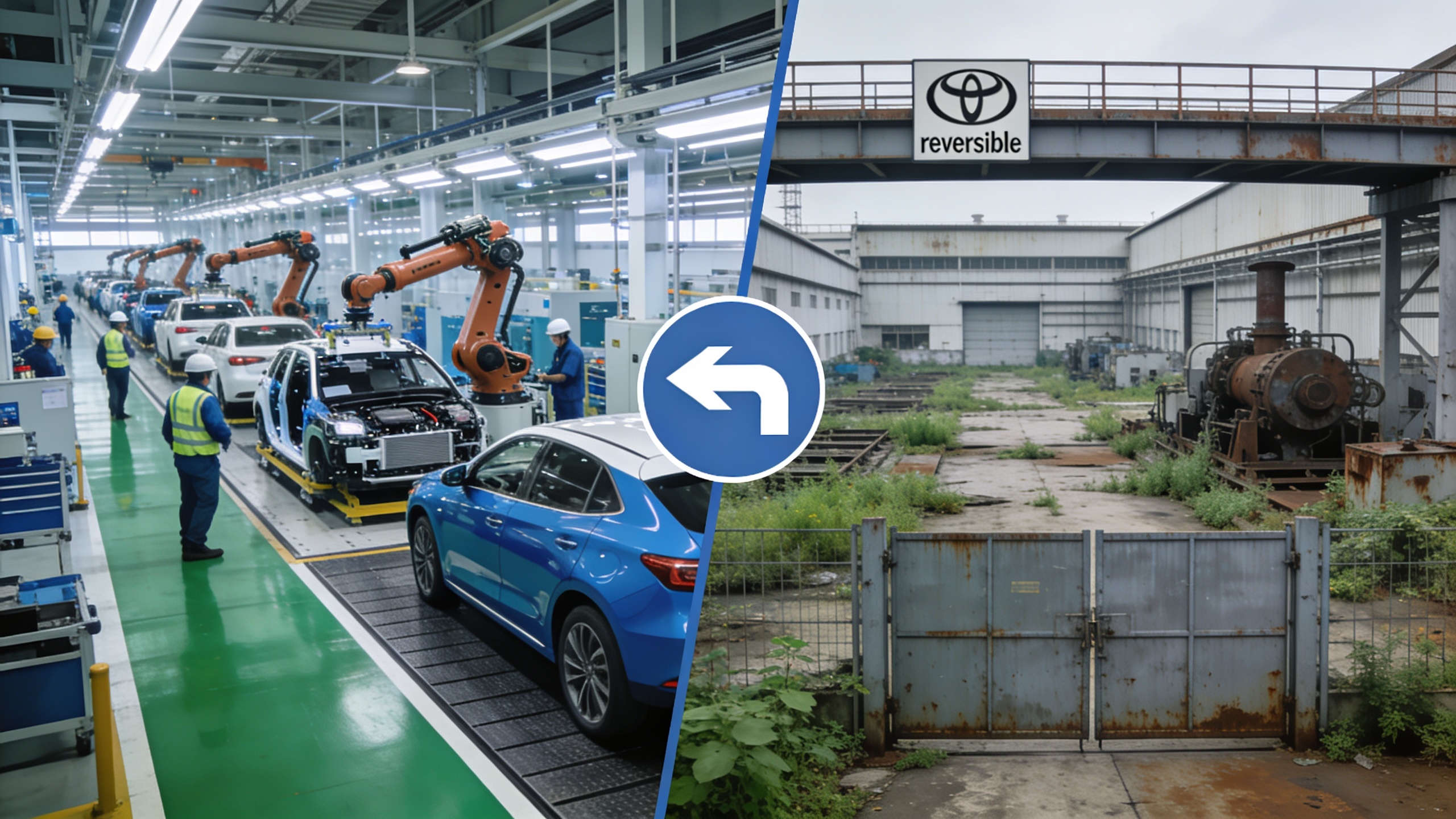
What Toyota’s “Two-Front Strategy” Reveals
Toyota Motor Corporation has decided to halt domestic development of next-generation EVs while continuing production in China. At first glance, this decision may seem contradictory, but it actually strikes at the heart of “reversible management.”
Many SME owners tend to view “withdrawal” as defeat. However, Toyota’s move expands future options by simultaneously withdrawing and continuing. The “withdrawal” of stopping domestic development is by no means an exit from the EV business itself. By gaining experience in the Chinese market, Toyota is buying time to assess technological progress and market shifts.
Why Was a “Reversible” Decision Possible?
Analyzing Toyota’s decision from the perspective of “reversible management” reveals three key conditions.
First, they chose “not all or nothing, but keeping a part.” Even if domestic development stops, production in China continues. This avoids the risk of completely losing EV expertise and supply chains. When SMEs exit a new business, keeping some functions or talent—rather than a full corporate withdrawal—can significantly lower the cost of re-entry in the future.
Second, the withdrawal is framed as a “strategic choice,” not a “failure.” Toyota is pursuing multiple technology paths simultaneously, such as hydrogen engines and hybrids. The decision to halt domestic EV development is about reallocating limited resources to other technologies, not a rejection of EVs themselves.
Third, decision criteria vary by market. China is the world’s largest EV market, with different regulations and subsidies. Because the assumptions differ completely from the Japanese market, the seemingly contradictory decision to “stop in Japan, continue in China” becomes rational.
The “Partial Withdrawal” Mindset SMEs Should Adopt
There is much for SMEs to learn from Toyota’s decision. The key is to view “withdrawal” not as simply stopping a business, but as resource reallocation.
For example, suppose a new business venture isn’t yielding expected results. Many owners tend to think in terms of “continue or quit.” But, like Toyota, there is the option to “keep a part.”
Specifically, consider these possibilities:
・Scale down the business itself, but redeploy the know-how and talent gained to other departments.
・Prioritize by market, focusing only on the most promising one.
・Stop doing it in-house and switch to external collaboration.
A manufacturing client I advised once exited a B2C service they had started as a new venture. However, they kept the marketing know-how developed there within the company and used it to strengthen their existing business. As a result, two years after the withdrawal, when market conditions changed, they were able to restart the same service at a low cost. This is a perfect example of a “reversible withdrawal.”
Three Points for Designing a “Reversible Decision”
Based on Toyota’s case, here are key points for SME owners to design “reversible decisions.”
1. Set Withdrawal Conditions in Advance
Toyota’s smooth decision to halt domestic development likely stemmed from having pre-set criteria for “when and how to decide.” For SMEs, when starting a new business, pre-defining conditions like “withdraw if sales don’t reach XX yen” or “scale down if not profitable within XX months” enables decisions free from emotional bias.
2. Separate What to “Keep” from What to “Let Go”
The hardest part of a withdrawal decision is drawing the line between what to keep and what to let go. Toyota let go of “domestic development” but kept “production in China.” For SMEs, consider these divisions:
・Talent: Even if the business is scaled down, keep excellent people in other departments.
・Technology/Know-how: Even if the business ends, preserve the knowledge gained as patents or manuals.
・Customers/Partners: Even when exiting a business, find ways to maintain relationships.
3. Estimate the Cost of “Returning”
When making a withdrawal decision, many owners focus only on “exit costs.” But what truly matters is the “re-entry cost.” If you completely shut down a business, how much time and money would it take to restart later? By continuing production in China, Toyota minimizes re-entry costs.
Even for SMEs, consider options like putting a business on hold rather than fully exiting, or outsourcing, to lower re-entry costs.
“Reversible Management” Is Strength, Not Weakness
Some may criticize Toyota’s decision as “weak” or say it makes Japan an EV laggard. But I believe the opposite. Leaving reversibility in your decisions—ensuring room to “come back”—is a source of long-term competitiveness.
Why? Because the business environment is always changing. A decision that seems right today may prove wrong six months from now. Whether you can “come back” at that point can determine your company’s fate.
By halting domestic development but continuing production in China, Toyota maintains the flexibility to adapt to technological progress and market changes. This is not “withdrawal” but “strategic standby.”
For SME owners, when making decisions about new businesses or investments, always ask yourself: “Is this decision reversible? What are the conditions for returning?” This habit will give you the strength to survive in an unpredictable era.
Withdrawal is not defeat. Rather, it is a stepping stone to the next victory. I hope you can learn the essence of “reversible management” from Toyota’s decision.
Comments