- The Common Pitfall Hidden in “Moon Landings” and “New Business Ventures”
- Is a “Single-Shot” Approach Truly Inevitable? The Perspective of Process Decomposition
- Three Moments That Make “Go/No-Go” Decisions Irreversible
- How SMEs Can Start Designing “Moon Landing-Level” Experiments Tomorrow
- Failure is Not the Endpoint, But the Most Vivid “Observation Data”
The Common Pitfall Hidden in “Moon Landings” and “New Business Ventures”
The private lunar exploration company ispace’s lander “HAKUTO-R” failed to land on the moon. To many business leaders, this news may have appeared as the “failure of a grand challenge.” However, the focus should not be on the “failure itself,” but rather on the structure of decision-making: “how the project was designed, and at what point it became impossible to turn back.”
Space development often conjures images of massive investment and a “single-shot” endeavor. It’s true that the moment of rocket launch or landing itself is physically irreversible. However, the “development process” and “business decisions” leading up to that moment actually contain many “branching points.” And this structure is surprisingly similar to when small and medium-sized enterprises (SMEs) embark on new ventures or make major investment decisions.
The essential question is this: “Has our challenge been designed from the start as something ‘we cannot return from’?” Let’s not treat ispace’s case as “someone else’s problem,” but instead use it as a mirror to reflect on our own decision-making processes.
Is a “Single-Shot” Approach Truly Inevitable? The Perspective of Process Decomposition
Technical analyses of ispace’s landing failure point to altimeter misidentification as one cause. It is said the altimeter misidentified the rim of a crater, judging “altitude zero” and cutting the engines despite still being some distance from the surface.
From a management decision perspective, what we should consider here is not “why did the design allow such a single point of failure (SPOF) to lead directly to decisive failure?” Rather, it is this point: “Was that risk ‘observable’ beforehand, and could the mission have been decomposed into ‘partial successes’ or ‘opportunities for learning’?”
The same thing happens with new ventures in SMEs. For example, making a large upfront investment to open a new store, only for the location or concept to completely miss the mark, renders everything futile. This is the same “single-shot” model as a “moon landing.”
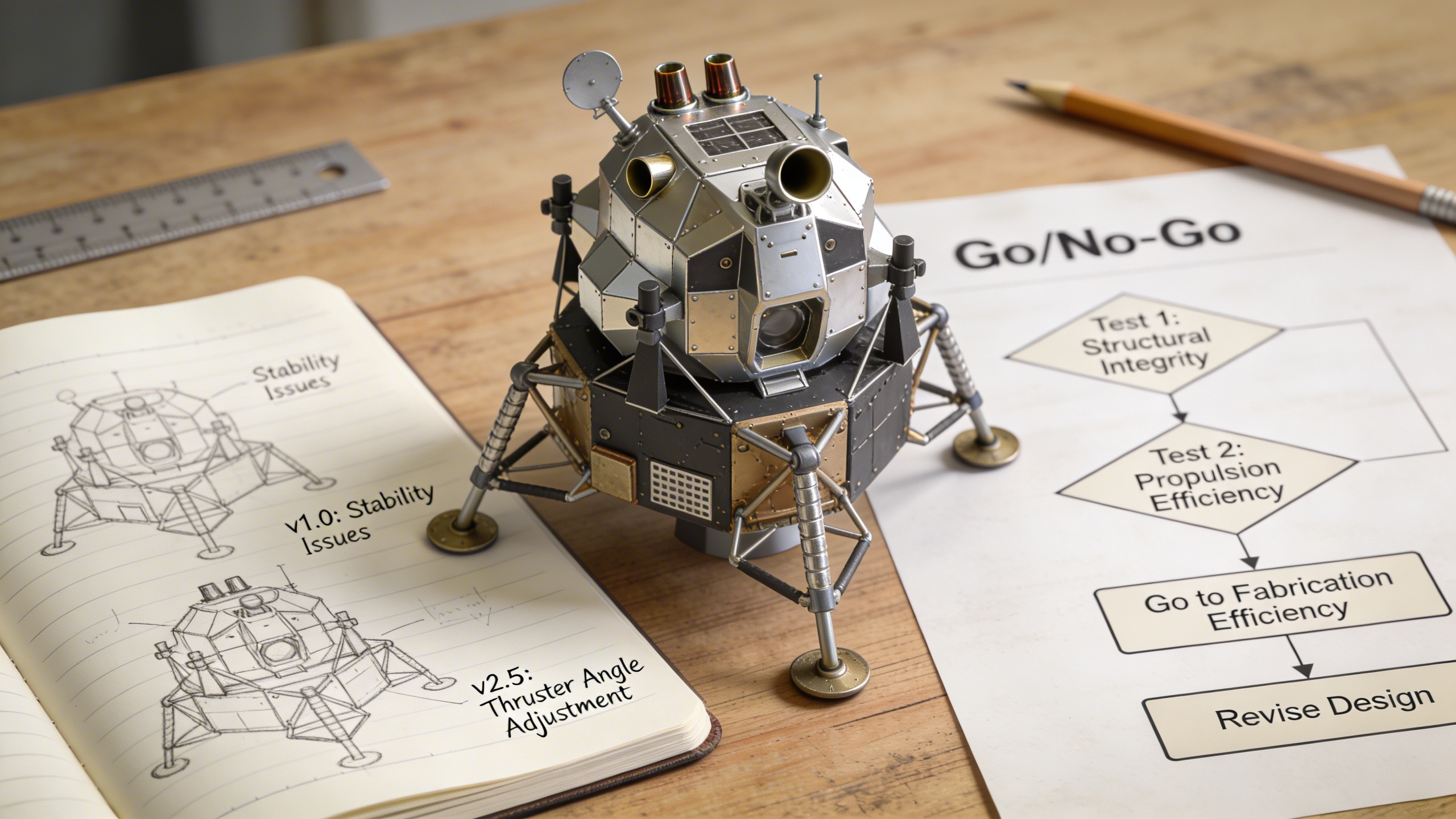
“Reversible Management” advocates for a perspective that “decomposes” this process. In the case of a moon landing, view each phase—”orbit insertion,” “cruise,” “landing”—as independent “experiments.” Even if the landing fails, the “partial achievements” and “data obtained” from successful orbit insertion or long-duration cruising remain firmly in hand. What’s crucial is whether a pathway for “how to utilize this next” is designed from the very beginning.
What to Evaluate is Not “Results” but the “Quality of Learning”
ispace does not position this mission as a “complete failure.” They assess that many objectives were achieved, such as reaching lunar orbit and long-duration operation. This is an extremely sound attitude.
A similar way of thinking is necessary for “experiments” in management as well. If we evaluate a new venture simply on a binary of “whether it became profitable or not,” then all the valuable insights gained in case of failure (customer reactions, unexpected costs, process issues) are discarded as “worthless.”
In reversible experimental design, we clearly define “what we want to learn” beforehand and evaluate the project based on whether those learning objectives were achieved. For example, if the learning objective is “to measure the effectiveness of web ads targeting a new customer segment,” then even if it doesn’t lead to direct sales, we obtain “results” like click-through rates, conversion rates, and user demographic data. If there is a pathway to utilize this learning in the next small experiment, the investment does not become a complete loss.
Three Moments That Make “Go/No-Go” Decisions Irreversible
In space development, a “Go/No-Go” decision is made before each phase. This decision becomes the branching point that makes the project irreversible. The exact same structure exists in management decisions. Reversibility is lost at the following three moments.
1. Fixation of Human Resources and the “Sunk Cost Bias”
Permanently assigning excellent personnel to a project and tying their careers and evaluations to its success. This is the most powerful force that “makes turning back impossible.” Even when the project begins to show dangerous signs, psychology like “we can’t let that team fail” or “we’ve come this far” takes over, making an objective “No-Go” decision impossible. ispace’s project surely had a passionate development team. How did management separate that passion from objective judgment?
Countermeasure: Form a “time-limited task force” for important experimental projects. Keep members’ primary affiliation in their original departments, and evaluate them based on balancing this with their main duties. This creates a structure where the “termination” of the project itself is not directly linked to an individual’s “failure” or “end of career.”
2. Early and Excessive Public Disclosure of External Commitments
Publicly declaring, “We will achieve a moon landing in 202X,” and gathering expectations from media, investors, and the public. While effective for fundraising, this simultaneously makes the cost of “turning back” enormous. The greater the expectations, the more any plan correction, delay, or especially cancellation rebounds as a major loss of credibility.
Countermeasure: Make commitments in stages and conditionally. For example, “If technology demonstration A succeeds, we will proceed to the next phase B and announce a concrete schedule at that time.” While setting bold goals internally, link external promises to “learning outcomes” to maintain flexibility.
3. Optimization for a Single Success Criterion
When all design is optimized solely for the single point of “successful moon landing,” other risks or opportunities for secondary learning become invisible. An example is excessive weight reduction of the lander leading to eliminated redundancy.
Countermeasure: Always establish multiple success criteria at the project’s start. For instance: Primary Goal (e.g., landing success), Secondary Goal (e.g., transmitting high-resolution images to Earth), Tertiary Goal (e.g., demonstrating long-term operation of the navigation system)… This creates a multifaceted perspective to evaluate the project’s overall value, even if the primary goal is not achieved.
How SMEs Can Start Designing “Moon Landing-Level” Experiments Tomorrow
So, how should SMEs with limited resources design “reversible experiments”? You don’t need a large R&D department. All you need is a thinking framework.
Step 1: Decompose the Project into “Learning Phases”
Decompose the new venture “moon landing” into “Orbit Insertion (market research, hypothesis building),” “Cruise (small-scale validation, prototype),” and “Landing (full-scale launch).” Mandatorily create an opportunity for a “Go/No-Go” decision at the end of each phase.
Step 2: Define the “Minimum Learning Objective” for Each Phase
In the “Orbit Insertion Phase,” set goals based on the “quality of learning,” not ROI—for example, “Identify 3 core issues from interviews with 10 prospective customers.” If this objective is achieved, consider the phase a “success,” even if the business hypothesis was wrong.
Step 3: Document the “Exit Conditions” and “How to Apply Learnings Forward” in Advance
Before starting each phase, decide “what data would lead us to NOT proceed to the next phase.” Furthermore, think ahead to “how the insights gained in this phase (whether success or failure) can be applied to part A of our existing business,” and even prepare a report template. This ensures no “waste” is created even if the project ends.
Step 4: Commit Resources on a “Tentative” Basis
Do not completely separate key personnel from their main duties; have them participate in a concurrent role. Make initial investments, as much as possible, in forms that are easy to cancel or scale down, like leases or cloud services. Think of it as “procuring all parts of the lander through rental, not outright purchase.”
Failure is Not the Endpoint, But the Most Vivid “Observation Data”
ispace is already advancing plans for its next mission, “Mission 2.” The “raw failure data” obtained from Mission 1 is likely being applied to the next design with value surpassing any success.
This attitude is critically important in management as well. “Reversible Management” is not management that is unafraid of failure. It is management that designs from the outset a “process to reliably learn from failure and reliably connect that learning to the next small step.”
What is the “moon landing” currently being planned in your company? Has that challenge become an all-or-nothing, single-shot endeavor? Decompose the process, set learning objectives, and decide exit conditions in advance. That slight difference in design can transform the challenge itself into an “endless experiment.” Even failure can be reclaimed as part of the trajectory of growth.


Comments