この判断が問題になる場面
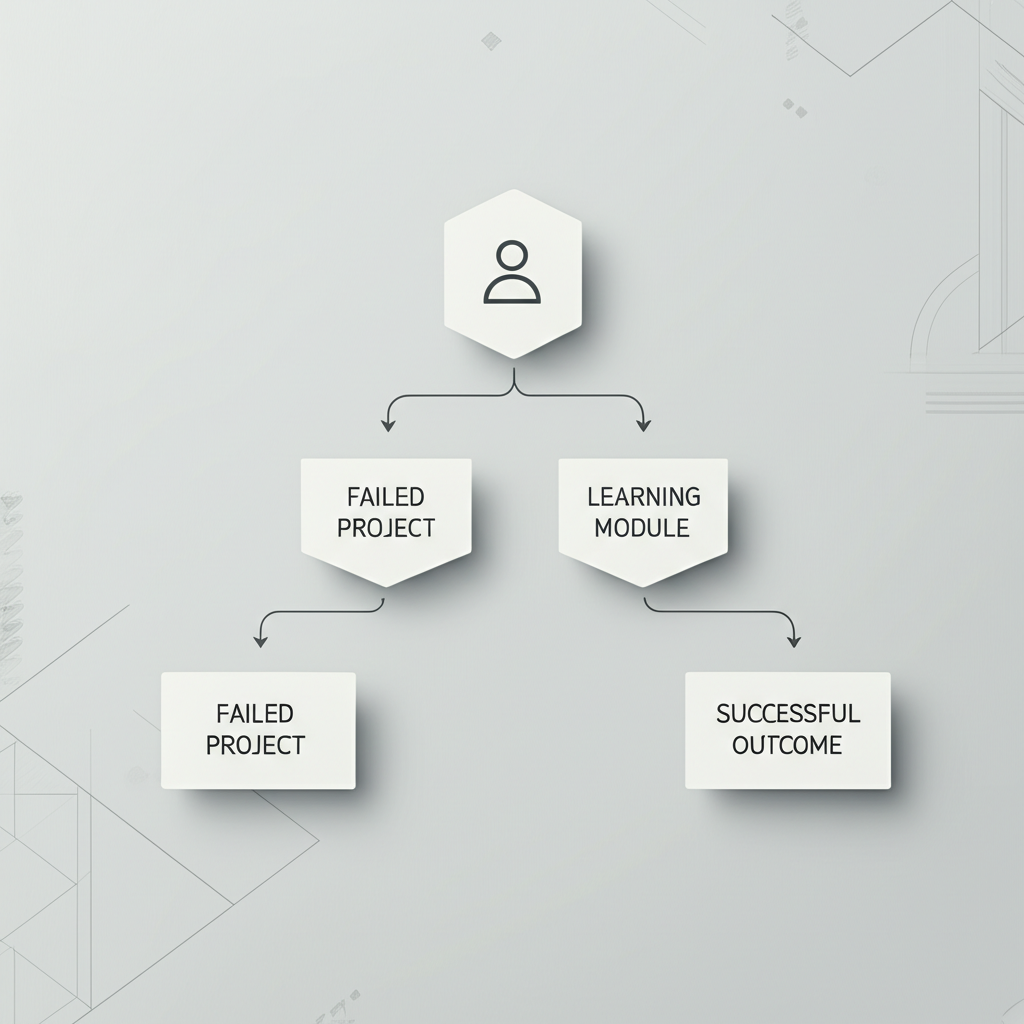
The idea of “recording and sharing failures, institutionalizing reviews to avoid repeating the same mistakes” is common in many organizations. However, in reality, records often become a mere formality, sharing ends as a temporary warning, and the crucial decision-making (management judgment) itself rarely changes. The real problem in such situations is not the lack of awareness about handling failure, but whether concrete rules and operational processes exist to transform the experience of “failure” into “the next decision.”
なぜ「失敗共有」だけでは足りないのか
When failure is not treated as an organizational “structure,” the following tends to happen. Failures are discussed as isolated incidents but are not broken down into specific decision conditions or premises, ending with vague admonitions like “be more careful.” As a result, these failures are not referenced during the next decision-making process, remaining merely as knowledge and failing to become assets that enhance the quality of management judgment.
失敗を構造に変えられない典型パターン
失敗が結果論で整理される
Only the unsuccessful events (results) are listed, without deconstructing the reasoning behind the decision or the underlying premises and assumptions. Consequently, the conditions under which the failure might recur remain unclear, making it impossible to formulate preventive measures.
責任の所在が先に確定する
Inquiries into “whose mistake it was” or “which part was wrong” take precedence, pushing the examination of the premises and criteria that informed the original decision to the back burner. This leads to attributing blame to individuals and prevents organizational learning.
失敗が評価と結びついている
In a culture where reporting failures negatively impacts personal evaluations, the incentive to record them honestly and in detail is lost. Consequently, failures disappear—either concealed or downplayed—before they can be structured and analyzed.
構造として扱われる失敗の共通点
Conversely, in organizations where failures are leveraged for “the next decision,” there is a clear difference in how failures themselves are handled. Failures are positioned as “judgment assets” for organizational learning.
判断前提として切り出されている
“Which premise was incorrect?” and “Which assumption did not hold?” are clearly identified and organized. The focus is not on the result, but on the decision-making process itself.
再発条件が言語化されている
“Under what conditions could a similar failure occur?” and conversely, “What conditions must be met to avoid it?” are articulated concretely and accumulated in a form accessible to everyone.
次の判断で必ず参照される
Past failure records are integrated into the verification process before new decisions are made or authority is delegated. Failure records that lie dormant without being referenced cannot be considered structured.
失敗を構造として扱うためのルールの考え方
The “rules” referred to here are not about penalties or strict control. They are the minimum “connection points” designed to reliably transform the experience of failure into management judgment and operational processes. For example, consider formalizing basic distinctions like the following:
- Organize failures not as “results” but as “premise deviations.”
- Record and retain them not as isolated incidents, but in the form of reproducible “conditions.”
- Ensure recorded failures are always included in the checklist for the next similar decision.
If these connection points are not functional, no matter how many failure cases are collected, the organization’s judgment will remain unchanged, and it will not lead to reversible decision-making.
ルールが機能しなくなる境界線
Rules for handling failure become hollow and lose meaning in the following scenarios: when records are kept but have absolutely no impact on decision-making; when unreferenced failure records pile up; or when the act of recording and analyzing failures itself becomes the goal. In this state, while failures may appear to be managed, the organization is not truly becoming wiser (learning).
この判断を考え直すための問い
To examine your organization’s approach to failure, try answering the following questions.
- Which decision premise did your most recent failure update?
- Is that failure designed to be referenced in the next decision-making process?
- Is the failure retained merely as an “incident,” or is it retained as a “condition”?
- Is structuring failure perceived as an evaluation risk, or as a valuable judgment asset?
If you cannot answer these questions clearly, the problem likely lies not in the number or frequency of failures, but in the absence of organizational or rule design to convert “failure” into “the next management decision.” For SMEs to grow with limited resources, this “ability to structure learning” is essential.


Comments