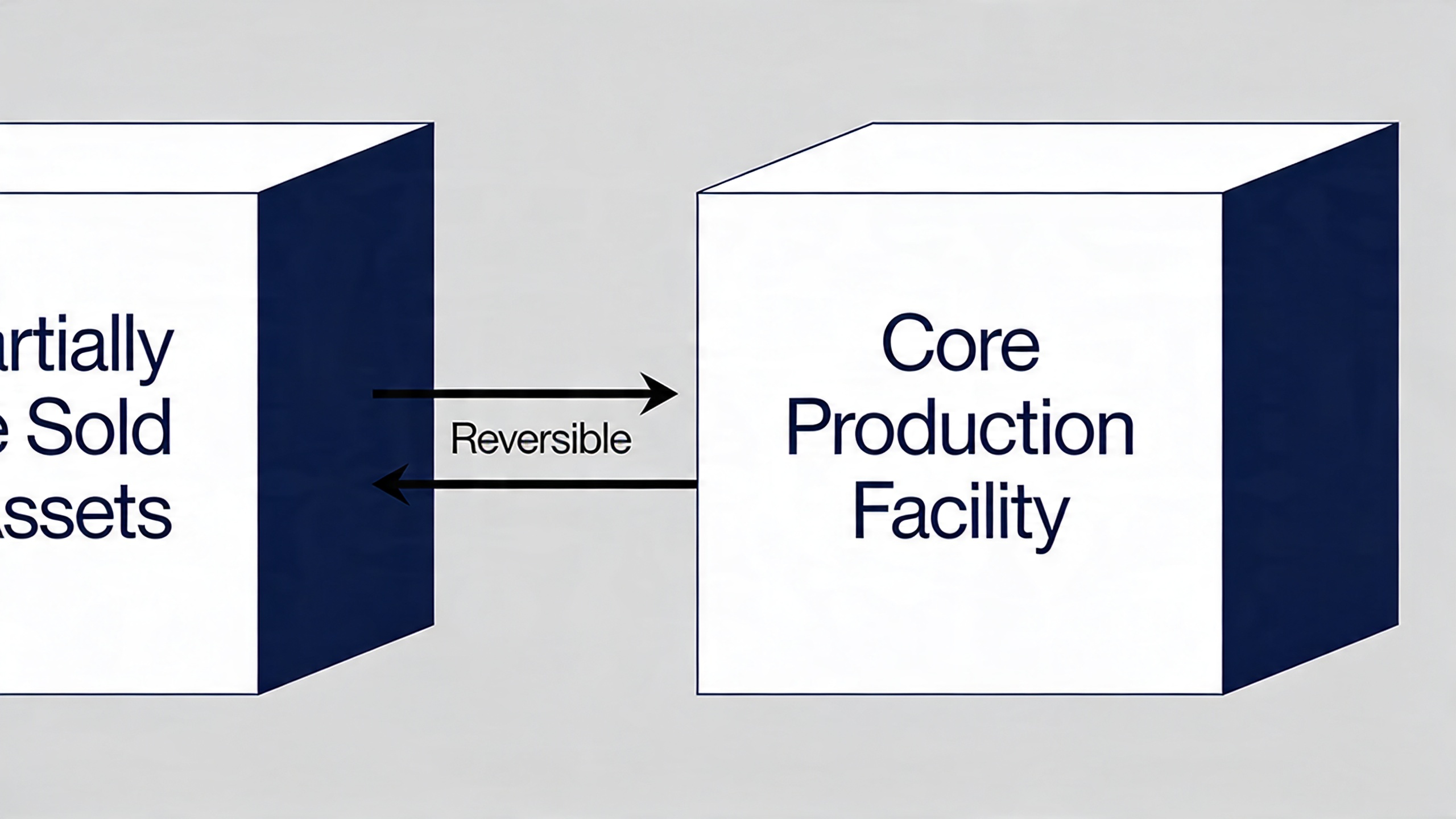
Sapporo Holdings is moving forward with a restructuring of its U.S. operations. This move, which combines the transfer of some assets with the consolidation of production bases, represents a form of modern management decision-making that goes beyond simple “withdrawal” or “downsizing.” Particularly noteworthy is the fact that it is designing a third option that is neither a “full withdrawal” nor “maintaining the status quo.” This can be seen as a practical example of “reversible management,” which minimizes risk while preserving future possibilities.
A “Partial and Reversible” Business Restructuring, Not a Binary Choice
Overseas operations, especially entry into large markets, are both an aspiration and a source of fear for many small and medium-sized business owners. Success promises significant growth, but a single failure can result in enormous costs and lost time, often shaking the very foundations of the business. Traditional decisions have tended to be binary choices: “enter or not,” “withdraw or continue.”
However, Sapporo HD’s current move breaks this simple paradigm. According to reports, the company is pursuing a complex restructuring in its U.S. operations involving the transfer of some assets while consolidating production at specific bases. This is not about postponing the decision to either “sell” or “protect” the entire business. Rather, it can be interpreted as deconstructing the components of the business (assets, production functions, sales networks, etc.) and making optimal, highly reversible decisions for each.
For example, selling non-core assets to generate cash while preserving and consolidating core production capabilities to improve efficiency. This limits potential losses if the market deteriorates (fixing the downside through asset sales). Simultaneously, if the market recovers or new opportunities arise, the option remains to expand again based on the retained production functions (preserving upside potential).
The Flexibility in Decision-Making Created by “Deconstructing Assets”
The core of this approach lies in not viewing a “business” as a monolithic block. When many managers say, “that business was a failure,” it often encompasses various elements—sales, production, logistics, brand—all blended together. But was everything truly a failure? Were there no elements with value that could be leveraged for the future?
From the perspective of “reversible management,” the first step when considering withdrawal or restructuring should be “deconstructing the business.” Specifically, it involves evaluating by separating elements such as:
- Physical Assets: Factories, equipment, real estate. Can they be sold or repurposed?
- Human Assets & Know-How: Insights, networks, teams gained locally. Can they be repatriated to the home country?
- Processes & Functions: Capabilities in production, development, sales, etc. Can parts be downsized/consolidated for efficiency?
- Contracts & Rights: Sales agency agreements, licenses, etc. What are the termination costs?
Sapporo HD’s case combines decisions at different layers on top of this “deconstruction”: “partial sale of physical assets” and “consolidation of production functions.” Asset sales are a relatively irreversible decision, but the consolidation of production functions is, in theory, reversible and could be decentralized again depending on circumstances. In this way, by intentionally combining decisions with varying degrees of reversibility, they are designing an overall balance of risk and flexibility.
Observation Point: How to Manage the “Connections” After Deconstruction
When deconstructing a business and making different decisions for its parts, the most critical point to watch is the moment when the “connections” between elements are lost, making it difficult to turn back. For example, closing a specific factory to consolidate production bases and disposing of its dedicated equipment. Even if the market recovers later, the same quality product cannot be made without that equipment. This is the moment of “no return.”
Therefore, key observation points when executing such a restructuring are as follows:
- Separation of Core Competencies: Are the assets to be sold clearly separated from the core technologies/know-how that should be preserved for the future?
- Maintenance of Interfaces: Even after selling assets, is the design such that the interfaces with the company’s own production/sales processes (data linkage, quality standards, etc.) can be maintained?
- Triggers for Re-expansion: Has it been predetermined in advance what indicators (e.g., growth rate in a specific market, successful test sales of a new product) would trigger re-expanding the consolidated production functions?
In the case of Sapporo HD, one observation point would be the extent of expansion capacity (land, potential for equipment enhancement) that the consolidated production base retains for potential future demand recovery.
Business Restructuring as an “Experiment in Withdrawal”
We often tend to view withdrawal or business restructuring as a “final decision.” However, the concept of “reversible management” proposes designing this as an “experiment.” An experiment always comes with a hypothesis, a verification method, and a way to “revert” or “proceed in a different direction” in case of failure.
Interpreting Sapporo HD’s approach through this framework, it can be organized as follows:
Hypothesis: “In the U.S. market, by selling some assets and consolidating production, we can significantly reduce fixed costs while maintaining the core business foundation. This will improve profitability and allow us to continue the business while preserving future options.”
Verification Method (Evaluation Period & Observation Metrics): For example, “Within two years, post-consolidation production costs are reduced by XX%, and market share for specific key products does not fall below YY%.” Cash inflow from asset sales is also a clear metric.
Method for Reversal in Case of Failure (Designing Reversibility): This is most important. If quality issues arise after production consolidation or flexibility is lost leading to opportunity losses, how will it be handled? For instance, preparing specific “reversal” measures at the decision point, such as “securing adjacent land to the consolidated Factory A with a two-year lease option for immediate expansion if needed” or “keeping replacement equipment for the sold Line B as backup at a domestic factory.”
Designing this as an “experiment” also has the effect of lowering psychological barriers. By viewing it not as “the defeat of a complete withdrawal” but as “a stage in exploring the optimal business structure,” both management and on-site personnel can engage in more objective and constructive discussions.
The “Deconstruction and Restructuring” Mindset SMEs Can Adopt Starting Tomorrow
The case of a large corporation like Sapporo HD might seem too different in scale. However, the mindset of “deconstructing the business and making decisions considering reversibility for each element” is applicable to companies of any size.
For example, when closing an unprofitable retail store, instead of simply labeling it “closure,” try deconstructing it:
- Physical Assets (Store Property): Terminate the contract and let it go completely, or switch to a short-term contract and preserve it as a warehouse?
- Human Assets (Store Manager/Staff): Lay off everyone, or transfer promising personnel to other stores or head office functions?
- Processes (Sales Know-How Cultivated at That Store): Can locally effective sales promotion techniques be applied in other regions or to e-commerce?
- Customer List: Is there a way to transfer it to another nearby store? Can customers be guided to online purchases?
By deconstructing in this way, a path for a “reversible retreat” that preserves reversibility and future potential becomes visible—not “store closure = losing everything,” but “terminating the property contract, yet utilizing personnel and know-how in other forms, and maintaining customer contact online.”
The key to increasing the reversibility of decisions is to avoid, as much as possible, the choice between “stop everything” or “continue everything,” and instead intentionally create intermediate options. Sapporo HD’s case is a perfect demonstration of this practice. Withdrawal from a market is not necessarily a black-or-white decision. How to design the gray options and leave a door slightly open to the future within them—that is the wisdom of “reversible management” for surviving an era of high uncertainty.


Comments