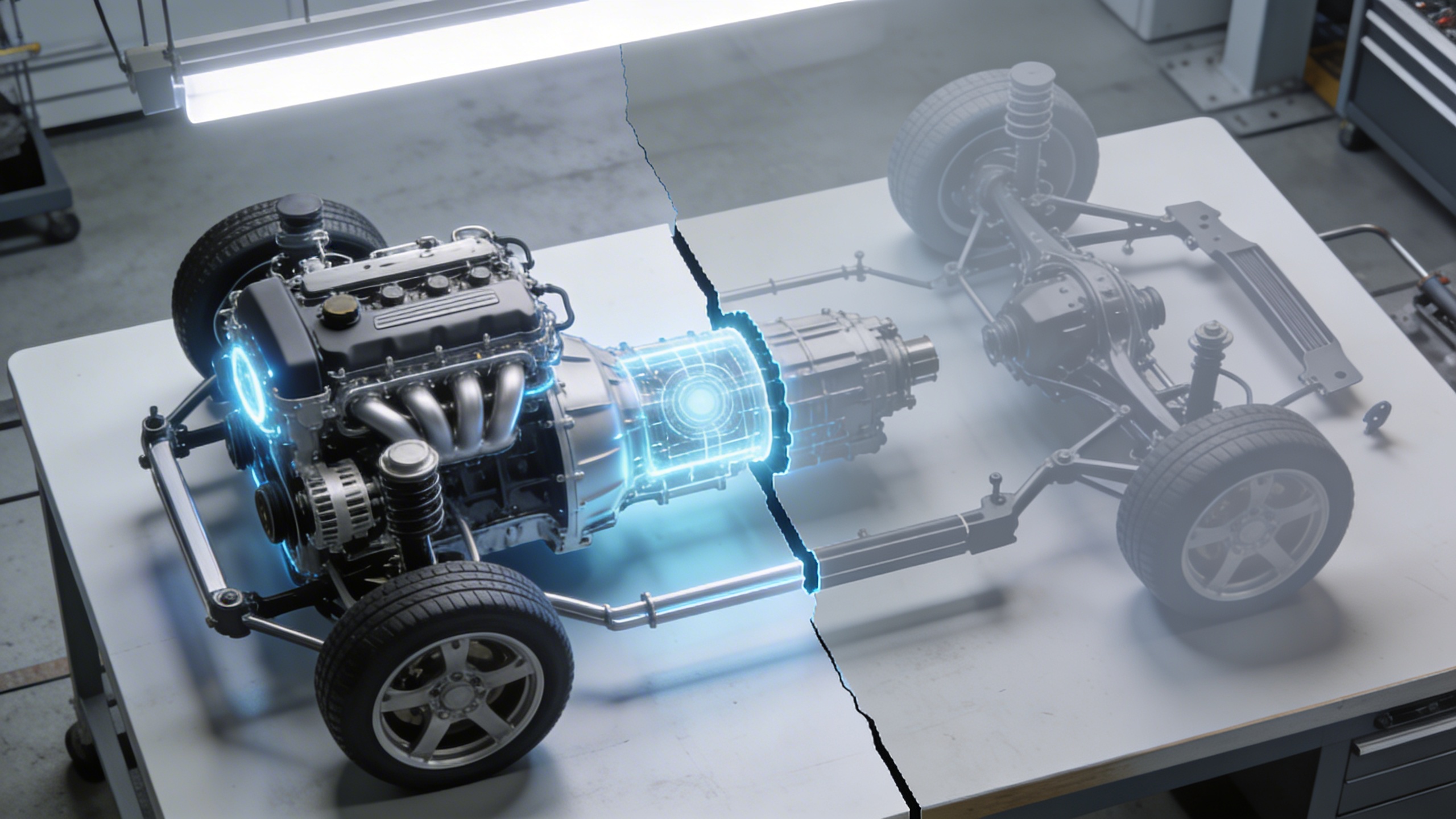
The “Irreversible Decision” Born from Attachment to Technology
Subaru has decided to exit the kei car business. While many media outlets have reported this news from the perspective of “its relationship with Toyota” or “intensifying market competition,” a more fundamental issue emerges when viewed through the lens of “reversibility” in management decisions. It is a structure where attachment to one’s own “proprietary technology” or “commitments” makes the decision to exit extremely difficult, solidifying a point of no return for an extended period.
Subaru is known for proprietary technologies like the horizontally opposed engine and all-wheel drive. It’s not hard to imagine they tried to uphold this technological philosophy in their kei car business as well. However, in the fiercely cost-competitive and regulation-bound field of kei cars, maintaining excessive technical commitments likely became a major factor squeezing profitability.
What we should focus on here is the mechanism of how “technology” makes management decisions “irreversible.” Technology requires massive investment for development and is deeply tied to engineers’ pride and corporate identity. Once positioned as “our company’s core,” even if it becomes unprofitable as a business, a psychological and emotional lock engages: “Letting go of that technology means denying our company.” Subaru’s case is a classic example of this “technological nostalgia” robbing management of reversibility.
The Danger of Defining “Technology to Protect”
Many small and medium-sized business owners also unconsciously fall into a similar trap. The belief that “our company is committed to this manufacturing method” or “this proprietary know-how is everything” can sometimes be a strength, but it can also become the source of rigid decisions that hinder flexible adaptation to environmental changes.
One fundamental principle of “reversible management” is to “look at the work, not the people.” This can be applied to technology as well. In other words, instead of sanctifying the “technology itself,” focus on the “work” it performs (the value provided to customers, its problem-solving function).
In Subaru’s case, rather than fixating on the “horizontally opposed engine” technology itself, it might have been possible to reconsider from the “work” perspective of how to realize customer value like “driving stability from a low center of gravity” or “low vibration.” Doing so would reveal that the means to achieve that value are not limited to the horizontally opposed engine. It creates room to experimentally try more profitable, “reversible” options, such as other technologies, alliances, or changes in parts procurement.
The moment technology is defined as a “sanctuary to protect,” all decisions related to that technology become irreversible. Investment continues, exit becomes taboo, and eventually, the entire business sinks, dragged down by that technology.
The “Faith in Technology” That Couldn’t Have an Evaluation Period
In reversible management decisions, it is crucial to set “evaluation periods” and “exit conditions” in advance for all new initiatives or existing businesses. For example: “We will invest 3 years and 10 billion yen in this new technology development. If market share does not reach 5% in 3 years, we will freeze the project and transfer the technology to other businesses or license it out.”
However, core technologies deeply tied to a company’s identity often escape this evaluation. The belief that “this is our company’s foundation” hinders objective profitability assessment and the setting of exit conditions. In Subaru’s kei car business, how clearly were investments in proprietary technology and business profitability separated and evaluated? Even if R&D costs were dragging the business down, weren’t they dismissed with phrases like “this is an investment for the future”?
This “faith in technology” is a form of structural nostalgia (a state where attachment to the past is embedded in systems and structures). As a Forbes JAPAN article points out, old ways survive not because they are rational, but because they are embedded in the organization’s structure, evaluation systems, and the identity of “who we are.”
The Mindset of “Separate Design” for Technology and Business
So, are we saying to abandon attachment and commitment to technology? Not at all. Rather, as a methodology to sustain that technology longer and more healthily, I propose “separate design.”
This is the idea of intentionally separating and managing “the technology itself” and “the business unit (business unit) that carries that technology.”
- Technology Unit (R&D / Development Department): Its mission is to refine the technology, explore new applications, and generate licensing revenue. Ideally, its budget should be covered by “research commissions” from business units, external funding, and licensing income.
- Business Unit (Product Development / Sales Department): Prioritizes market needs and profitability. It “procures” the necessary performance from the Technology Unit under cost-appropriate conditions. It has the authority and responsibility to choose the optimal solution, including external procurement, without being fixated on in-house technology.
If this separate design functions, the Business Unit is no longer forced into unprofitable choices simply because “it’s our own technology.” Theoretically, it becomes possible for the kei car business to decide, “We won’t use our own engine because it’s not cost-effective.” On the other hand, the Technology Unit can refine its technology without being swayed by the fate of a specific business, opening a path to prove its value through other businesses or licensing to other companies.
In fact, the capital and business alliance with Toyota was an opportunity for a kind of “external procurement” for Subaru. However, when a company’s technological identity and business are strongly intertwined, it may have been difficult to make that choice purely as a “best procurement source selection based on profitability.”
Three Observation Points for “Reversible” Technology Management
Is your company’s technology becoming a “sanctuary” that robs management decisions of reversibility? I recommend regularly observing the following points.
1. Transparency of Cost Attribution: How are the development and maintenance costs of that technology accounted for in which business’s profit and loss? If shared across multiple businesses, is the allocation fair? Are the Technology Unit’s costs unduly burdening a specific struggling business?
2. Verification of Alternative Procurement Possibility: If you were to procure that technology externally, how much would it cost? Or, can the customer value realized by that technology be achieved more cheaply by another method? Conduct regular external benchmarks.
3. Evaluation of Technology as an “Asset”: Is the only value in continuing to use that technology in-house? Could it become an independent revenue source through licensing to other companies or a spin-off? Shift perspective from “using” technology to “nurturing and leveraging” it.
Exit is Not the Death of Technology, But Its Liberation
Subaru’s exit from the kei car business should not be seen as mere “defeat” or “technology’s loss.” It can be interpreted as a decision to unlock the fixed, irreversible bond between “technology” and “an unprofitable business.”
The exit liberates management resources (human resources, capital, management attention) that were bound by the kei car framework. The proprietary technology, which may have been forced to bear an excessive burden to support the kei car business, now gets a chance to seek new avenues. For example, in the new era of electrification, how can the technical know-how of the horizontally opposed engine be applied to the design of next-generation powertrains or battery placement? Or, in what form can it demonstrate value as a technological asset in collaboration with other companies?
What management should fear is not exit from a single business itself. Rather, it is being unable to escape from an unprofitable bond due to attachment or identity. Technology does not exist to share the fate of a specific business. It only becomes a true part of “reversible management” when it is reframed as an “asset” that can traverse various businesses and opportunities.
Does your company also have technology or commitments that are like an untouchable “sanctuary”? Is it still exempt from冷静な採算評価, continuing to rob management decisions of reversibility? Subaru’s decision presents us with a valuable opportunity to fundamentally re-examine the relationship between technology and business from the ground up.

Comments