この判断が問題になる場面
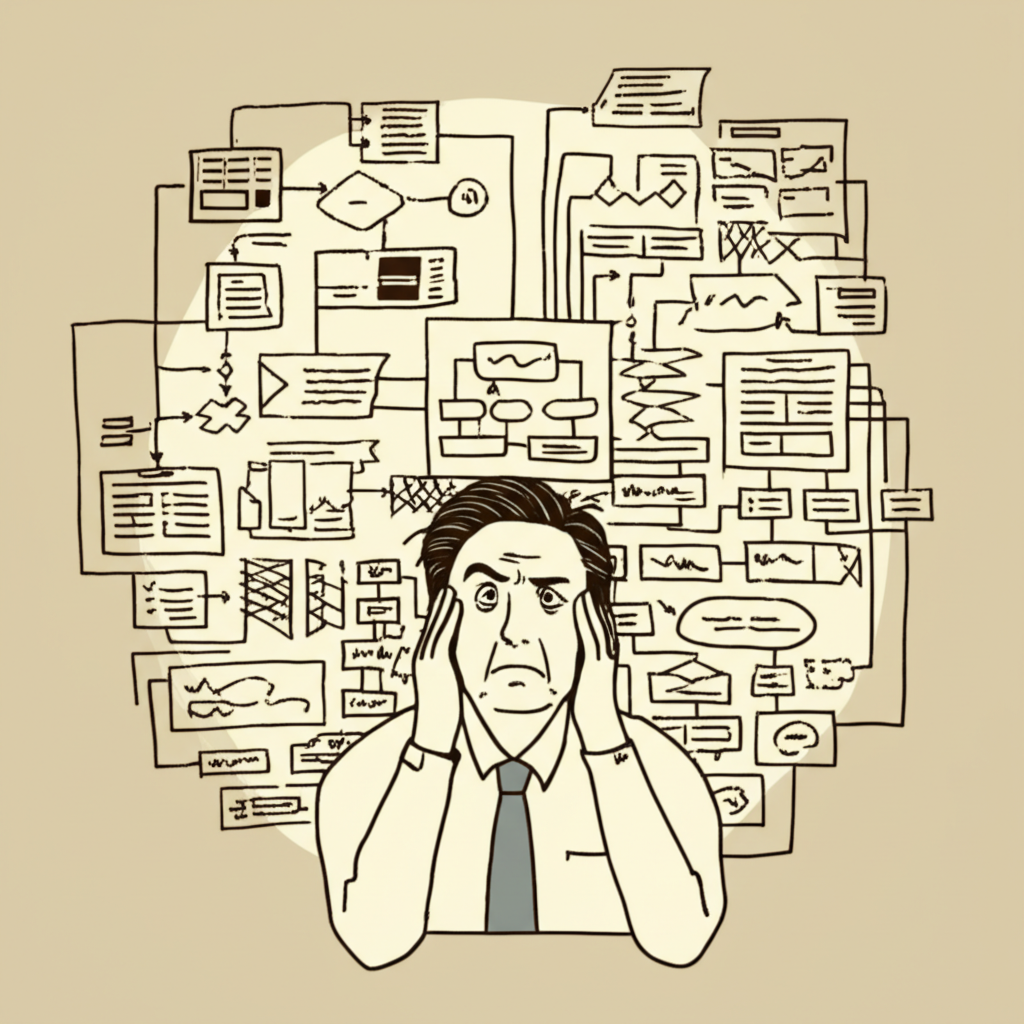
When operations become complex and voices from the field start saying things like, “Methods vary by person,” “It’s too dependent on individuals and feels unstable,” or “We won’t be able to keep up like this,” management decisions like “Let’s just get a system in place quickly,” “Let’s solidify rules to stop the chaos,” or “Let’s reduce reliance on human judgment” become more likely. The consistent motivation behind this is the desire to “prevent the chaos from spreading any further.”
システム化が「安全策」に見える理由
In a chaotic situation, systemization appears to be a safe choice because it can “standardize procedures” and “produce the same results regardless of who does it,” thereby reducing variability in judgment. In the short term, it may seem effective, reducing inquiries from the field and making problems appear to settle down. However, there is a crucial point that is often overlooked at this stage.
混乱の正体を見ないまま固めてしまう構造
When chaos occurs, what should be examined are points like: “Where are judgments diverging?” “Why is there variability in judgment?” and “What is still not understood?” However, rushing to systemize can lead to fixing that variable judgment as-is and freezing unorganized business processes as rules. As a result, the chaos is not resolved; it merely becomes invisible.
システム化後に起きる典型的な問題
In organizations that rushed to systemize to avoid chaos, the following phenomena are more likely to occur:
- Exception handling continues to increase.
- Workarounds outside the system become the norm.
- Complaints like “The system doesn’t fit our field operations” erupt.
However, by this point, changing or modifying the system risks causing new, significant chaos, making improvements even more difficult.
なぜ「早く固めた方が安全」に見えてしまうのか
The background to choosing this decision includes psychological factors such as believing “chaos equals failure,” not wanting to show an unstable state, and not wanting to be seen as lacking control. As a result, the priority becomes stopping the chaos itself before observing and analyzing it.
混乱が不可逆になるポイント
Whether systemization makes chaos fatal depends on the following points:
- Are people, roles, and evaluations fixed based on the system’s premise?
- Have contracts or investments taken an “irreversible form”?
- Was the premise for review after system implementation (reversibility) incorporated into the organizational design?
When these align, the system becomes a device for solidifying erroneous judgments rather than a tool for business improvement.
この判断を考え直すための問い
For SME management, what’s more important than the pros and cons of systemization itself is the design of the decision on how to handle chaos. Consider the following questions:
- What might the current chaos be trying to teach us?
- What will become invisible if we stop this chaos?
- What judgments will be fixed by systemization?
- Before solidifying, is there anything left that we should still observe?
If you cannot answer these clearly, the essence of the problem likely lies elsewhere, such as in unorganized business processes or inadequate delegation of authority. Reversible management decisions mean creating adaptable mechanisms that can be adjusted according to the situation, rather than making irreversible “solidifications.”


Comments