
この判断が問題になる場面
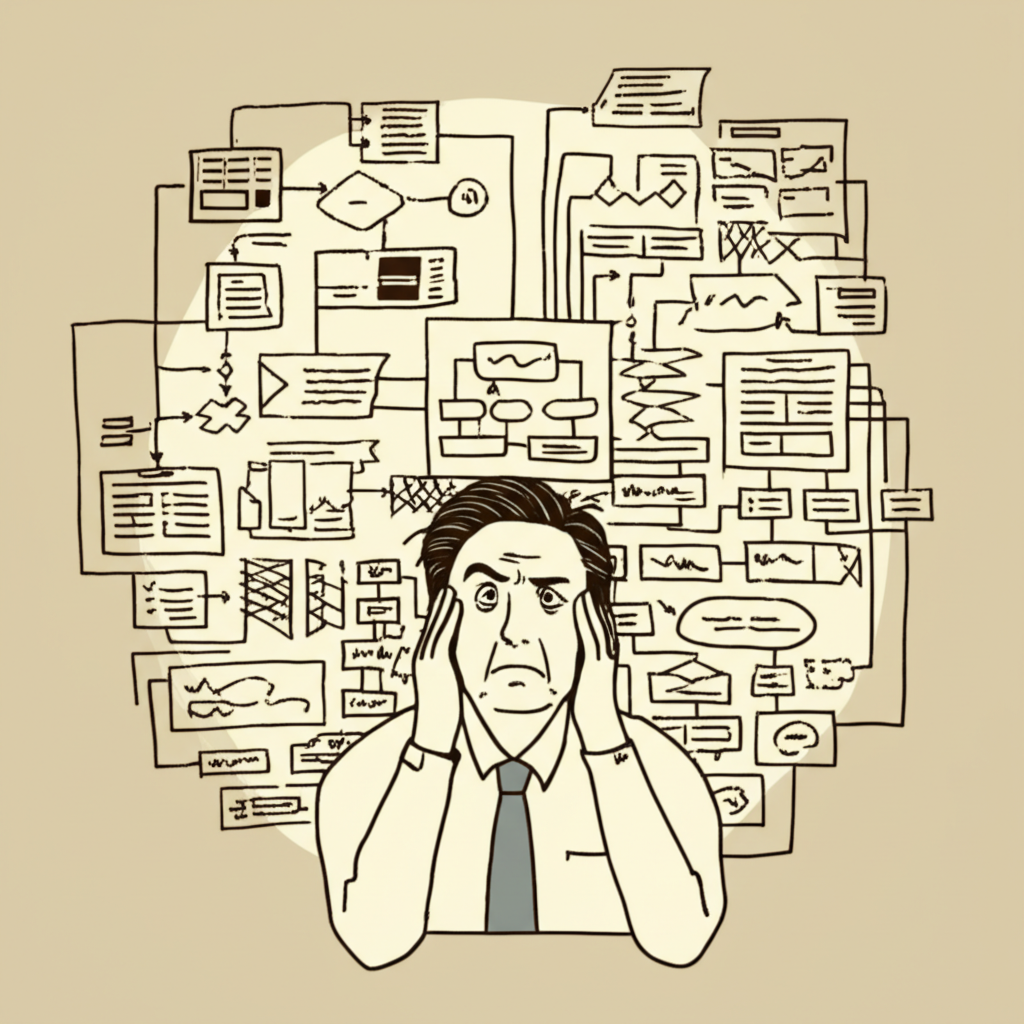
When starting a new initiative, changing a process or structure, or introducing new tools or rules, concerns almost inevitably arise: “Will this cause chaos on the front lines?”, “Things are stable now, so it’s better not to disrupt them,” or “We don’t want to create unnecessary trouble.” At this point, the debate often narrows down to a binary choice: “avoid chaos” or “proceed anyway.” However, the real question should not be whether to avoid chaos, but rather, “On what premise regarding how to handle chaos are we making this management decision?”
混乱を避ける判断が選ばれやすい理由
There are clear reasons why avoiding chaos seems rational. It is a fact that productivity temporarily drops, frontline dissatisfaction surfaces, and management and coordination costs increase—these should not be ignored. However, if this decision is repeated, an organization may maintain surface-level stability while its actual condition remains unobserved.
混乱を避け続けた組織で起きること
In organizations that are extremely averse to chaos, efforts to stop problems before they become visible lead to a cumulative effect: unexpected developments become invisible, and the information used for decision-making is not updated. What is happening here is not problem-solving, but merely the avoidance of problem exposure.
混乱が学習に変わるケース
On the other hand, there are organizations where chaos, when it occurs, is not fatal and is instead leveraged for future decisions. In these cases, premises are relatively well-organized: “Chaos is expected to occur for a certain period,” “The areas where chaos might occur are limited,” and “What to observe during chaos is shared.” Here, chaos is not treated as a failure in execution, but as a phenomenon for understanding the structure of work processes and organizational design.
混乱が致命傷になる境界線
Whether chaos leads to learning or moves toward collapse is not determined by the chaos itself. However, when conditions such as “people, roles, and evaluations are already fixed,” “contracts or systems are predetermined,” and “options to ‘revert’ or ‘stop’ are excluded from the start” overlap, chaos tends to become irreversible. In this state, chaos is often treated not as an opportunity for observation, but as an irreparable failure.
「学習を取る」が誤解される瞬間
The phrase “embrace learning” is often misunderstood as simply enduring chaos or pushing forward by burdening the front lines. However, learning, in its true sense, is about capturing what differed from expectations, where the gaps were, and which premises were incorrect, and then using that as material for the next management decision.
この判断を考え直すための問い
For SME leaders, being conscious of reversibility in management decisions is crucial. Consider the following questions:
- What is the scope of the chaos you are currently trying to avoid?
- If that chaos occurs, what could you learn from it?
- Is the premise of being able to revert (reversibility) still intact even if chaos occurs?
- Is the current stability a state of no problems, or a state where problems are simply not visible?
If you cannot answer these, the issue likely lies not in whether chaos is good or bad, but in the absence of a design to transform chaos into learning (such as delegated authority or observable work processes). To build an organization resilient to change, a perspective is needed that does not eliminate chaos, but accepts it within a manageable scope and incorporates mechanisms to learn from it into the organizational design.
Comments