
- When This Decision Becomes a Problem
- What Happens in Organizations Where Chaos Doesn’t Lead to Growth
- What Happens in Organizations That Can Transform Chaos into Learning
- Why “Chaos ≠ Information” for Many
- The Premise of Growing Organizations
- The Boundary Where Chaos Stops Growth
- Questions to Rethink This Decision
When This Decision Becomes a Problem
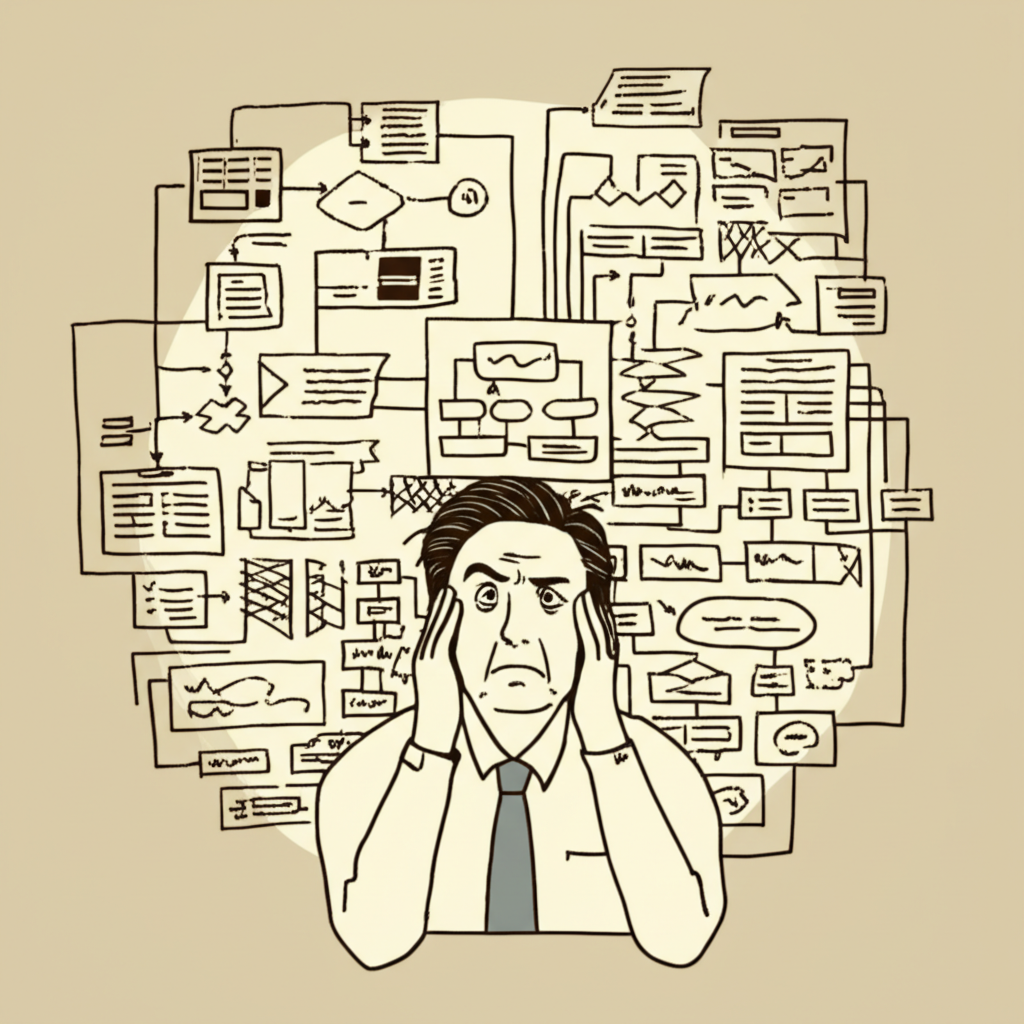
Whenever you launch a new initiative or change your approach or systems, “unexpected” situations inevitably arise within the organization. Complaints or unease may surface from the front lines, unforeseen setbacks may occur, or situations where it’s unclear who should make a decision may increase. Faced with such chaos, management decisions diverge into two paths. One is the decision to suppress the chaos and try to return to the original state. The other is the decision to treat the chaos as valuable information and attempt to observe and understand what is happening. At this fork in the road, the fundamental question is not whether the organization will grow, but whether it possesses a structure that enables learning.
What Happens in Organizations Where Chaos Doesn’t Lead to Growth
In organizations that instantly label chaos as “failure,” the following reactions are more likely to occur. First, the top priority becomes quickly returning to the original state, leading to a search for who is to blame rather than an investigation into the root cause. As a result, the actions that caused the chaos become stifled, the context of the chaos remains unexamined, and the organization fails to retain an understanding of what went wrong. While the chaos itself may subside, the organization’s decision-making capabilities and operational processes remain completely unchanged.
What Happens in Organizations That Can Transform Chaos into Learning
On the other hand, there are organizations where growth continues even when chaos occurs. In these places, chaos is treated not as an “abnormality” or “failure,” but as an “observation” or “verification data.” Points of failure are not attributed to individual responsibility but are structurally identified and analyzed as issues with the underlying assumptions, organizational design, or operational processes themselves. In this way, chaos accumulates within the organization as valuable knowledge, essential for informing the next management decision.
Why “Chaos ≠ Information” for Many
In many organizations, including SMEs, the reason chaos doesn’t translate into learning is not the chaos itself. If structures exist within the organization where “chaos is directly linked to personal evaluation and responsibility,” “admitting failure weakens one’s position,” or “policy adjustments or reversals are treated as negatives,” then reporting chaos candidly becomes a risk in itself. In this state, information stops surfacing, and it becomes impossible to make reversible decisions (decisions that can be corrected later).
The Premise of Growing Organizations
Organizations that can learn from chaos are not welcoming it. Their underlying premise is a mindset that “decisions are provisional,” “things will always differ from assumptions,” and “chaos arises to test our designs and assumptions.” Therefore, when chaos occurs, it is seen as an opportunity to update a decision, and that update is treated positively as a “premise adjustment,” not a failure. This is also a key characteristic of organizations where delegation of authority functions effectively.
The Boundary Where Chaos Stops Growth
Whether chaos becomes a learning opportunity or leads to exhausting stagnation that halts growth depends on the following conditions:
- Does the organization have a circuit for recording and verbalizing (visualizing) chaos?
- Is it clear who has the authority and responsibility to revise decisions based on the insights gained?
- Is the option to “revert” not dismissed from the outset (is reversibility guaranteed)?
If these are lacking, chaos becomes a cause of mere exhaustion and stagnation, not learning.
Questions to Rethink This Decision
To reflect on your company’s approach to management decisions, consider the following questions:
- What does this current chaos indicate was different from our assumptions?
- Is that difference a problem with an individual, or is it a problem with our premises, organizational design, or operational processes?
- Are we retaining anything from this chaos that can be leveraged for our next decision?
- Does the organization have a structure (psychological safety) where chaos can be reported safely?
If you cannot answer these questions, the problem likely lies not in the chaos itself, but in the absence of a mechanism to transform chaos into learning. For SMEs to achieve sustainable growth, management decisions that consider reversibility and organizational design that learns from failure are essential.
Comments