- The Common Thread in Two Seemingly Unrelated News Stories
- Muture’s Sponsorship: A “Temporary Placement” Investment in a Community
- AEON’s New Brand: The Store as an “Experimental Apparatus”
- Three Conditions for a “Reversible Experiment” Learned from the Two Cases
- Questions to Turn Your “Next Move” into a Reversible Experiment
The Common Thread in Two Seemingly Unrelated News Stories
Recently, two news items were reported. One was that the HR startup Muture became the platinum sponsor for the agile development community event “Scrum Fest Fukuoka 2026.” The other was that retail giant AEON, as part of reorganizing its supermarket business, opened the first store of a new brand, strengthening its prepared foods section, among other things.
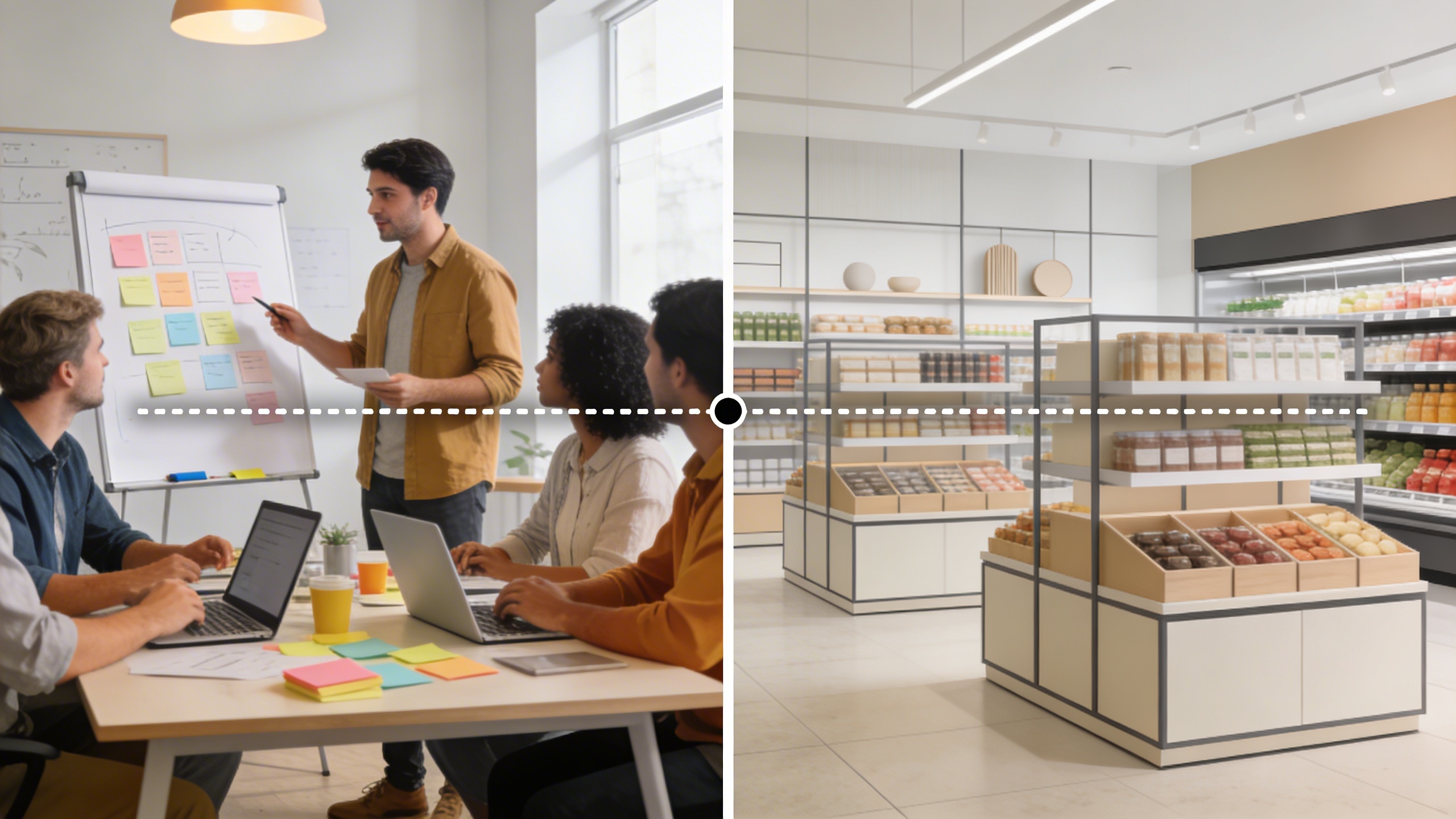
At first glance, these seem like entirely different matters: a tech startup’s marketing activity and a major retailer’s store strategy. However, when viewed through the lens of “reversible management,” these two moves reveal a surprisingly common core. It is the point that “before making a large-scale commitment, they are launching small, reversible experiments.”
When entering new markets or undertaking business transformations, many managers tend to pour in resources all at once, driven by a determination to “make it a success.” Yet, that is precisely the first step toward an “irreversible decision.” The moves by Muture and AEON provide practical examples of the opposite approach: “decisions as experiments.”
Muture’s Sponsorship: A “Temporary Placement” Investment in a Community
First, let’s analyze Muture’s sponsorship activity. Becoming the platinum sponsor for a major agile development festival is not merely an advertising campaign. This can be seen as a “temporary placement” investment in a specific community (agile practitioners), with defined duration and scope.
Muture’s core business is supporting the recruitment and development of specialized talent like engineers. Engineers practicing agile development are one of its key customer segments. So, what is the best way to reach this segment? Is it to plan large-scale seminars in-house, incurring fixed costs for ongoing operation? Or is it to participate as a sponsor in an already established community “festival”?
Muture’s choice of the latter reflects a design for reversibility.
- Clear Evaluation Period: The sponsorship contract is likely per event or per fiscal year. It can easily be positioned as a one-off “experiment.”
- Specific Observation Points: Outcomes can be measured numerically, such as booth traffic at the event, number of leads generated, and conversion rate to recruitment activities.
- Ease of Withdrawal (Reversal): If the effectiveness is low, they can simply opt out of the next sponsorship. Compared to launching their own event, assigning dedicated staff, and solidifying a brand, this is far easier to “reverse.”
In the decision-making pattern of “hiring people vs. decomposing tasks,” this is a prime example of avoiding the “commitment to people” represented by “solidifying an in-house community management team as an organization,” and instead choosing the “decomposition/temporary placement of a task” through the temporary involvement of the “sponsor role.” The community itself exists externally, and the company remains merely a “user” of it. This is the key to reversibility.
AEON’s New Brand: The Store as an “Experimental Apparatus”
Next, let’s look at AEON’s launch of a new brand. When a large corporation launches a new brand, it often becomes a major project involving huge investments and a multi-year roadmap. However, reading the reports carefully, this move is part of “supermarket reorganization,” with a particular focus on “strengthening prepared foods, etc.”
The design of the “reversible decision” here can be inferred as follows.
AEON already has existing supermarket brands, operational know-how, and a supply chain. The new brand is likely positioned not as building everything from scratch, but as an “experimental apparatus” built upon existing resources to test a specific hypothesis (e.g., high-value-added prepared foods will be accepted in this location).
- Brand Design Avoiding Fixation: Although it’s a new brand, it is probably not made completely independent from the group’s overall brand assets, maintaining some relevance to limit the impact if the experiment fails.
- Limiting the Focus of Enhancement: By focusing on “prepared foods, etc.,” they are treating a specific section or product group as a “variable,” rather than changing the entire store. This is easier to observe and adjust than revamping the entire product assortment.
- The Scale of a “First Store”: Starting with a first store instead of a nationwide rollout. This is the very setting of an “evaluation period.” They can observe the performance at this store, verify the hypothesis, and then decide whether to expand, pivot, or terminate.
This approach clearly chooses the latter in the decision between “perfecting before moving” and “running reversibly.” Instead of “perfecting” a flawless brand strategy and store concept before a mass rollout, they start running with minimal resources, leaving room for adjustment while observing the “reality” of market response.
Three Conditions for a “Reversible Experiment” Learned from the Two Cases
From the cases of Muture and AEON, we can extract specific conditions for designing management decisions as “reversible experiments.”
Condition 1: Limit the Commitment Object to a “Role,” Not a “Function”
Muture did not become “the operator of the agile community” but adhered strictly to the role of “sponsor of its festival.” AEON is not creating “a completely new retail company” but is assigning the new brand the role of “experimental store operation within the existing system.” By defining the object not as a solidified entity like an “organization” or “brand,” but as a temporary “role,” a clean break becomes possible: end of role = end of experiment.
Condition 2: Set Observable “Intermediate Metrics” in Advance
It is dangerous to judge whether an experiment failed based solely on the final profit and loss. That makes the judgment too late. For Muture, it could be “the number of high-quality conversations at the event”; for AEON, it could be “the repeat purchase rate at the prepared foods section of the new brand store.” It is essential to establish metrics that can be observed in the “process” leading to the final outcome. If these metrics are unfavorable, a decision to pivot or terminate the experiment can be made before further investment is committed.
Condition 3: Decide the “Deadline for Termination” and the “Fallback Position” Before Starting
This is the most crucial point. Before starting an experiment, always decide two things.
First, “When to evaluate.” Is it at the next budget planning period, a quarterly review, or after the event? Set a temporal checkpoint.
Second, “Where to fall back to if the experiment is stopped.” For Muture, even if they stop sponsorship activities, their core business remains intact. For AEON, even if they close the new brand store, they should have a planned “fallback position,” such as feeding back the prepared foods know-how to existing stores or converting the store itself to an existing brand. Without this decided, the psychological cost of “we’ve come this far” can lead to irrational decisions to continue.
Questions to Turn Your “Next Move” into a Reversible Experiment
Now, in your company as well, “next moves” like entering a new market, developing a new product, or small-scale organizational restructuring may be under consideration. Before turning that decision into an irreversible commitment, ask the following questions.
- In this plan, what are we trying to “solidify”? (e.g., a dedicated team, a new brand name, an expensive tool contract)
- Is there a way to achieve this without “solidifying” it, perhaps as a temporary “role” or “time-limited trial”?
- What are the “intermediate metrics” that can indicate success/failure before the final outcome?
- If we were to stop this trial, where would we “return” the resources (people, money, customer relationships)?
Muture and AEON differ in scale and industry, but they appear to be moving while answering these questions. Management is a dialogue with uncertainty. Not every decision can be correct. That is precisely why the essence of “reversible management” lies in the design of how to minimize damage and how to quickly get back on a recovery track when a decision proves wrong.
At your next strategy meeting, instead of immediately discussing the final plan, why not start with the question: “First, how can we test this in a small, reversible way?” That first step can be the best investment to prevent major failures and build learning and adaptability within your organization.


Comments