
想定読者の状態(Before)
Many business leaders who feel challenged by their dependence on outsourcing or external experts may be thinking, “Shouldn’t we bring this in-house?” They might expect that in-house development will speed up decision-making, return authority to the company, and strengthen governance. However, they are likely facing a dilemma where signs of stagnation or confusion in decision-making within the newly in-house domain have begun to appear, and governance hasn’t improved as much as they had hoped.
議題設定(What is the decision?)
The crucial management decision addressed in this article is to clarify why the notion that “bringing it in-house will strengthen governance” often proves to be an illusion. This question is important because when problems with outsourcing surface, many leaders tend to jump to the simplistic conclusion that “the problem is because it’s outsourced; bringing it back in-house will solve it.” However, simply moving personnel in-house without changing the “design of the decision-making process,” such as how decisions are made and authority is delegated, does not solve the fundamental problem.
結論サマリー(先出し)
In-house development itself does not automatically guarantee stronger governance. The essence of the problem lies not in the choice between in-house or outsourcing, but in the “method of decision-making (the design of how decisions are made).” The correct design principle is to clearly separate decision-making authority and roles, regardless of whether the work is done in-house or outsourced. This article does not reject in-house development; rather, it dismantles the illusion of viewing it as a panacea and provides material for considering more effective organizational design.
前提整理(事実・制約)
The business objective here is to sustainably improve the quality and speed of decisions. The constraints to recognize are: (1) in-house personnel can also fall into sub-optimization, (2) in-house development tends to increase fixed costs and dependency on specific individuals, and (3) even after bringing functions in-house, the ultimate management responsibility remains with the leadership. Given these premises, it becomes clear that the simple equation of “in-house equals stronger governance” does not hold.
内製化で起きがちな失敗構造
In organizations where in-house development falls short of expectations, the following structure is often observed.
- A specialized department hoards decisions, creating a black box.
- It becomes difficult to voice dissent simply because “they are the in-house experts.”
- As a result, the organization falls into a state where the external vendor is merely replaced by an internal one (shifting from externalization to internalization of decision-making).
This is a typical failure pattern of in-house development that does not review the design of business processes or authority.
本来あるべき内製化の位置づけ
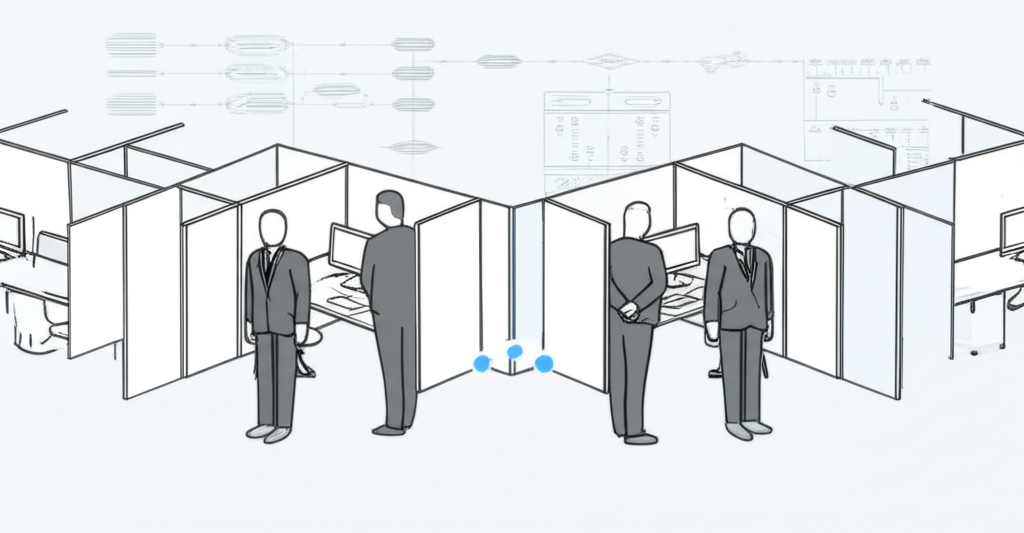
In organizations where in-house development functions effectively, the focus is not on “who does it (the person)” but on “how decisions are made (the design).” Specifically, while the leadership retains final decision-making authority, the in-house department is limited to the role of creating decision-making materials (options and their risks/benefits). Just like an external vendor, they are obligated to present multiple options and their conditions. In other words, true in-house development means not “bringing the decision itself inside,” but “possessing the internal capability to support high-quality decision-making.”
経営判断としての分業
For effective in-house development, clear division of labor between management and the in-house department is necessary.
- Management’s Role: To determine business objectives and priorities, define acceptable risks, and make the final decision from the presented options.
- In-house Department’s Role: To organize specialized constraints, present multiple realistic options as material for management’s decision, and support the decision-making process with their expertise.
The moment this division of roles breaks down and the in-house department becomes the de facto decision-maker, in-house development becomes a factor that weakens governance rather than strengthening it.
よくある失敗パターン
The main failure patterns associated with in-house development are the following three.
- The In-House Panacea Fallacy: The assumption that “because it’s in-house, it’s safe and correct.”
- Over-Reliance on Individuals: Decisions become concentrated on specific capable individuals and are not accumulated as organizational knowledge.
- Lack of Verifiability: A culture where questioning is discouraged simply because “the in-house expert said so.”
All of these are problems that arise from treating in-house development merely as a “staffing measure” without deeply considering it as a “design” or “business process” for decision-making.
After(読了後の経営者)
With the perspective from this article, business leaders will be able to calmly differentiate between using in-house and outsourced resources based on logic rather than emotion. The important thing is not “who does it” but “how decisions are made,” and they will develop the perspective to inspect the very structure of decision-making itself, beyond just staffing. As a result, in-house development will be appropriately positioned not as a solution to all problems, but as one “strategic option (a means)” that proves effective when properly designed.

Comments